The first page
Two royal brothers enter the story before we meet the sisters. The narrative on this leaf is printed in English.
Open original scan 5 ↗The Arabian Nights
In Lucknow, Munshi Newal Kishore published Scheherazade’s tales in Urdu verse. His press later offered an illustrated Urdu translation and an English edition sold in four parts. Open the English book and meet the two sisters who have one night to change a king’s mind.
In 1862, a reader in Lucknow could open the Arabian Nights and find Urdu poetry. Rekhta’s account credits Munshi Newal Kishore with the choice of a masnavi, a story told in rhyming couplets. Mirza Asghar Naseem rendered the first volume into verse. In 1880 the Press published an illustrated Urdu translation by Ratan Nath Sarshar, the author of Fasana-e-Azad. By 1909 the publishing house was offering Sindbad his own 39-page Urdu book.
The copy open here is in English. Its title leaves name the “Newul Kishore” Press in Lucknow and carry dates of 1890 and 1891. An advertisement bound into the book prices each of its four parts at eight annas. This was the choice facing a customer at the Press counter. Which part would you take home first?
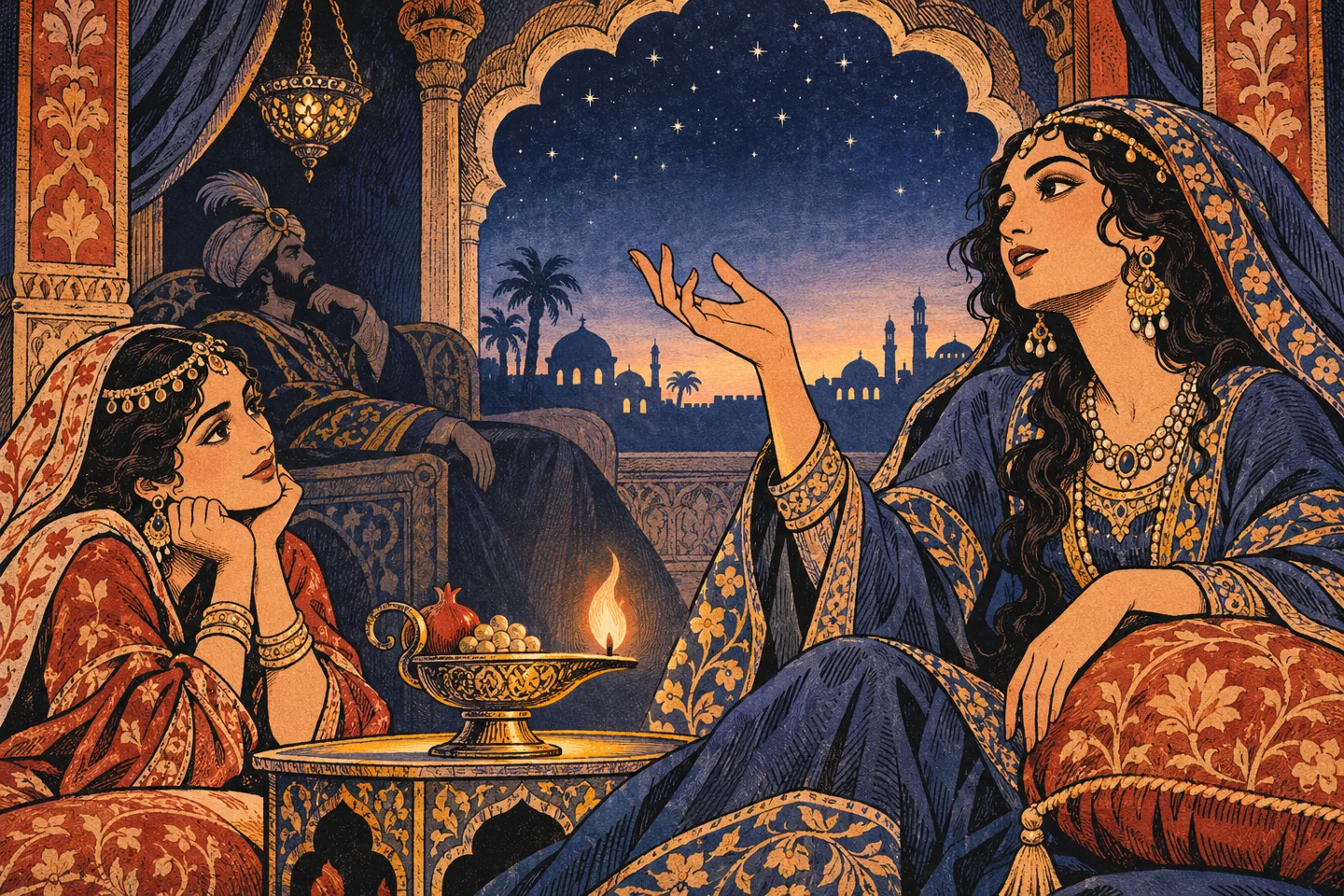
Leave the bookseller’s table for a royal court in the world of the tales. King Schahriar has discovered his wife’s betrayal. He has her killed, then turns his anger against women who have done him no wrong. He marries a new bride each evening and orders her death the next morning. His vizier, the minister who must carry out the order, has two daughters. The elder, Scheherazade, asks to be the next bride.
She cannot command the king, but she knows how to tell a story. Before the wedding she asks her younger sister, Dinarzade, to come to the palace and give her a cue just before dawn. What happens next depends on whether a man who has already made up his mind can be persuaded to listen.
The fourteen chapters follow selected tales from this copy. When the telling passes from Scheherazade to Sindbad, or when the museum moves past intervening tales, the text marks the change. The journey ends where the sisters began.
Read the introduction · Read from the beginning →
Begin with the sisters, follow the seven voyages at Sindbad’s table, then read the three later tales and return to the royal court.
The two sisters are always in the royal chamber, even when a story takes us to sea. Follow one of those stories inward, from the king’s bedside to a merchant ship.
Dinarzade asks. Scheherazade tells. Schahriar listens and decides whether there will be another morning.
Hindbad voices a complaint. Sindbad invites him to dinner and starts to explain the cost of his fortune.
Young Sindbad steps ashore. The sailors light a fire. What feels like firm ground begins to move.
The royal court belongs to story time. Bagdad, Balsora, the island of Serendib and an imagined China all enter the sisters’ room through the telling. The dates on the Lucknow title leaves belong to the life of this particular printed book.
At the press a part was advertised for eight annas. A buyer could begin with a single part, a different way of encountering a tale that made its first listeners wait until the next night.
Begin the illustrated story →Look for a price, a printer’s name and an ending that hides in plain sight. These nine objects come from the digitised Lucknow copy.
In which part would you land if you turned forward from the end of Part II in this copy? Take a guess, then compare the two orders.
Enlarge a leaf or open the same page in the complete scan. Scan numbers count the PDF’s cover and endpapers.
Two royal brothers enter the story before we meet the sisters. The narrative on this leaf is printed in English.
Open original scan 5 ↗An advertisement for English books puts a reader of the Nights in the company of customers buying law books and Baital Pachisi. The price list continues on the next page.
Open original scan 323 ↗Follow the four entries for the Arabian Nights across to the prices. Each part costs eight annas. At sixteen annas to the rupee, the whole set comes to two rupees.
Open original scan 324 ↗The name printed beneath Lucknow is “Newul Kishore” Press. The date below it is 1890. This is the first dated inner title leaf on our reading trail.
Open original scan 325 ↗Read the inner title leaf, then turn two scans to the opening of the text. Both identify Part IV. The outer wrapper points the reader in a different direction.
Open original scan 659 ↗The closing page of Part IV gives the outcome of the sisters’ plan. Look for the short paragraph after the king’s speech, where private news spreads beyond the palace.
Open original scan 845 ↗The numbered inner title and the text two scans later identify Part III. The printed year is 1891, the same as Part IV.
Open original scan 851 ↗The last narrative leaf breaks during a sentence about the succession. Following it are endpapers and the binding. Scheherazade’s own conclusion survives earlier, on scan 845.
Open original scan 1060 ↗A bookplate names the Sri Ramakrishna Ashram Library in Srinagar. It records one place this copy was kept after it left the press.
Open original scan 3 ↗Internet Archive catalogues this English volume under 1887. No dated title leaf precedes Part I in this scan. The surviving inner title leaves give 1890 for Part II and 1891 for Parts III and IV. They print the Lucknow imprint as “Newul Kishore” Press and describe the work as translated from Arabic without naming a translator.
The museum retellings, dialogue and colour illustrations were made in 2026. The nine photographed leaves are archival facsimiles. The copies provide the printed words and the page evidence, including the broken final line of Aladdin.
Complete digitised volume · Internet Archive / eGangotri ↗Rekhta credits Munshi Newal Kishore with choosing the masnavi form. Mirza Asghar Naseem rendered this first volume into Urdu verse. Look at how the lines sit in pairs on the page.
Open at Rekhta ↗Ratan Nath Sarshar, author of Fasana-e-Azad, translated this illustrated Urdu edition. Rekhta’s copy runs to 1,073 pages.
Open at Rekhta ↗The publishing house gave the sailor an Urdu booklet of his own. Compare its 39 pages with the space Sindbad occupies in the four-part English book.
Open at Rekhta ↗You entered the palace with two sisters who had one night. You leave it with a father who can come to the door in the morning without fearing the order he will hear. To see how the Lucknow edition gives this last moment to the family, turn to the heading “Conclusion” on scan 845. There is still a thick sheaf of paper after it. The inner titles tell you why.