A printing legacy, reimagined through adaptive reuse and digital discovery.
Before a book reached a reader, it passed through a world of hands, rooms and machines.
Explore that working world inside the Le Press 3D campus in Hazratganj, Lucknow. Read the historic plan, discover the publishing legacy and follow a page from type to dispatch.
An online museum experience. This does not announce the opening of an on-site museum.
ONLINE NOW · FREE TO EXPLORE
What is the Newal Kishore Press Virtual Museum?
The Newal Kishore Press Virtual Museum is Le Press’s free online interpretation of the historic printing works in Hazratganj, Lucknow. Explore 28 departments, animated printing processes, narrated stops and a reading room linking to digitised archival books.
Newal Kishore Press, also written as Nawal Kishore Press or Naval Kishore Press, was founded by Munshi Newal Kishore in Lucknow in 1858. Le Press is the present-day adaptive reuse of the historic campus at 29, Naval Kishore Road, Hazratganj.
Available online: explore from home in your browser. Physical museum: an on-site opening has not been announced. The 3D machinery and room assignments are interpretive reconstructions, not a surveyed historical inventory.
Press Start to hear the tour with original ambient music. Audio never starts automatically.
Loading the 3D museum…
Big barn · letterpress printing
Welcome to the early printing works. Four cylinder letterpress exhibits fill the big barn. Raised metal type receives ink, and a rotating impression cylinder presses paper against the printing surface. Watch the flywheels, inking rollers and moving sheets. The hand presses in the next department show another way of transferring words to paper.
Illustrative letterpress equipment, not an authenticated inventory of the machines installed in 1860.
Machine motion is a simplified illustration of movement, not an engineering simulation. The tour uses a recorded Indian English narrator, with a device voice available if recorded audio cannot play. Original synthesised ambient music plays softly beneath the narration. Pause, mute and volume controls are available; captions remain visible.
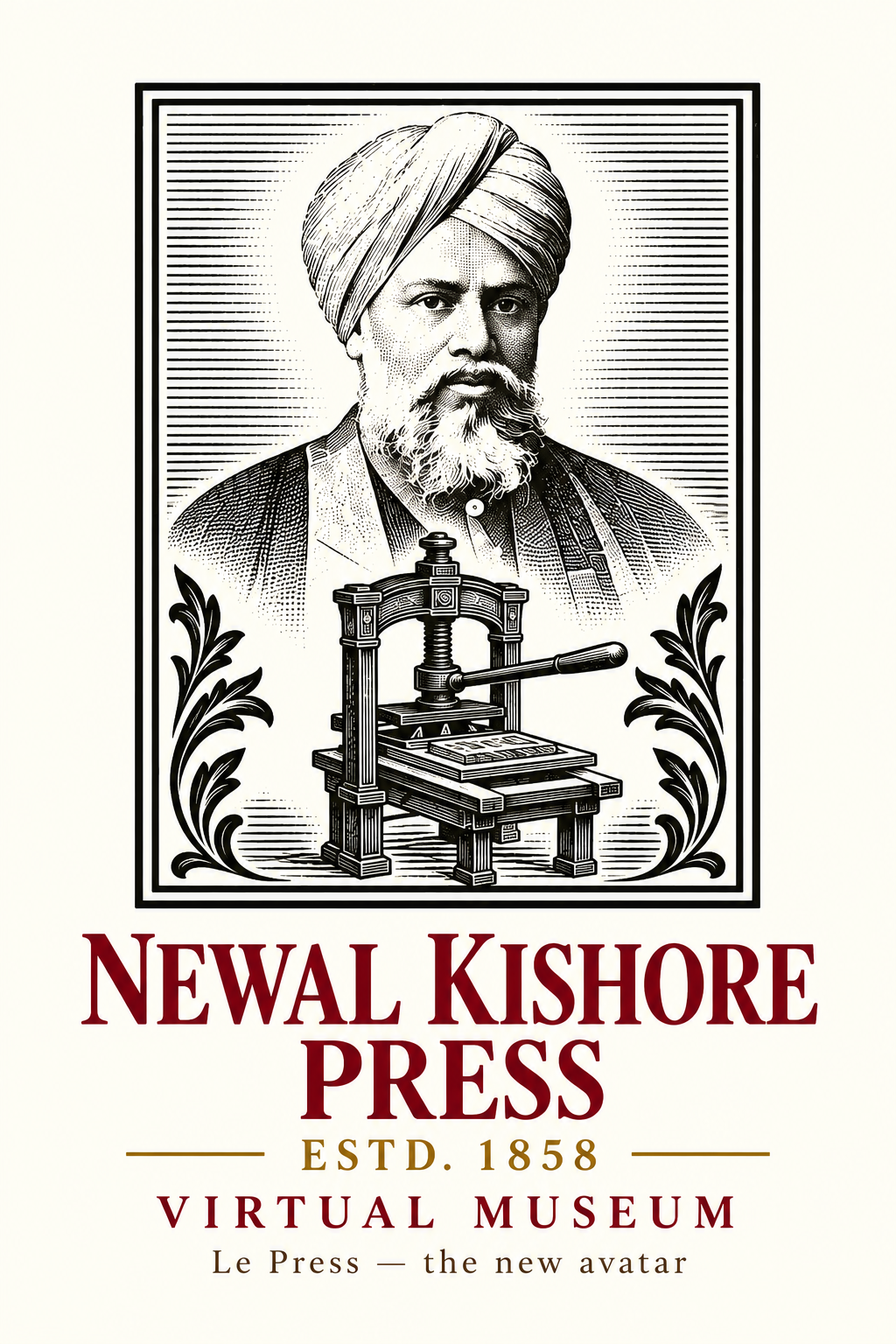
Workers evoke nineteenth-century North Indian dress. Munshi ji’s mature figure is inspired by the historical portrait above, with a wrapped turban, beard, coat, shawl and medallion; it is not an exact likeness or a depiction of his age in 1860. This tour uses letterpress machinery for the early printing period. Clothing references: INTACH: traditional men’s costumes of Lucknow and V&A: an Indian jama, c.1855.
A later chapter, 1960: According to the family history supplied by the Le Press team, Shri Tej Kumar Bhargava, great-grandson of Munshi Newal Kishore, installed offset printing machines in 1960. Those later machines are not shown in this early-period tour.
Interpretive reconstruction: equipment is illustrative, not an identification of original machines. Department markers are approximate; the archival plan and the present-day model have not been surveyed into a single coordinate system. Later retail partitions are hidden in museum mode to reveal an interpretive production floor. The normal campus tour retains them. Most machinery, furniture and figures evoke the early printing era. The Madhuri editorial office is a separately labelled twentieth-century chapter; the c.1860 figures are hidden when it is selected. Exact historical inventories and room assignments have not been established.
THE SCREENING ROOM · 6 MIN 1 SEC
Printing Through the Ages
Watch the film, then return to the 3D museum to explore the working press.
Paper receiving and storage supply the press rooms. Composition, proofreading, lithographic drawing and engraving prepare the printing surfaces. Press operators make the impressions; drying and inspection precede folding, sewing, trimming and binding. Finished books move to the book store, with packing, order records and dispatch alongside it, outside the big barn.
Printing ink and dye storage sits with the production workshops, separate from paper and finished books. Maintenance supports the machines; editorial and accounts offices support the publishing work. Door approaches and work aisles remain part of the layout.
Settle into an adventure, a puzzle or a short reflection. These English reading companions open as readable text, with e-book download options on Project Gutenberg. They offer another way into the literary worlds explored by the museum; they are separate editions, not English editions issued by Newal Kishore Press.
01 · ADVENTURE & WONDER
The Arabian Nights
Selected and edited by Andrew Lang · English
A fisherman hauls up a sealed vessel. A sailor sets out on another impossible voyage. These stories reward curiosity, ingenuity and the pleasure of one tale leading to another.
Start with: The Story of the Fisherman. For a longer escape, try The Seven Voyages of Sindbad the Sailor.
Compare with the 1887 Naval Kishore Press scan in the original-editions section below. Lang’s selection is a different edition.
02 · RIDDLES & CHOICES
Vikram and the Vampire
Richard Francis Burton’s English adaptation
A determined king carries a strange storyteller through the night. Each tale tests judgement: who deserves credit, whose promise matters, and what makes an answer just?
Start with: the Introduction to meet the king and his elusive companion, then read the first tale.
An English companion to the Baital Pachisi storytelling tradition discussed in our heritage pages. Burton’s adaptation is not a Newal Kishore Press edition and reflects nineteenth-century language and attitudes.
03 · A MOMENT TO REFLECT
Gulistan · The Rose Garden
Sa’di · English translation by James Ross
Brief encounters with rulers, travellers and dervishes turn into reflections on character, contentment and the words we choose. Read a single anecdote, then return for another.
Start with: Chapter III, On the Preciousness of Contentment, or Chapter IV, On the Benefit of Being Silent.
For readers interested in original scripts, typography and publication history. These scans complement the English selections above.
Tarikh-i Firishtah · 1896
An Urdu historical work by Firishtah, published in Lucknow by Munshi Naval Kishore. This digitised copy comes from the University of Toronto’s Robarts Library.
Look closely: compare the flowing script, dense text blocks and narrow margins across successive pages.
The eGangotri archive identifies this scan as the 1887 Naval Kishore Press edition. Explore the title matter and printed text in the original digitised volume.
Original scans and catalogue records: Internet Archive, University of Toronto / Robarts Library and eGangotri. Select a full-book link to turn pages in the holding archive’s reader. The preview is an archival thumbnail; the full scan provides the reading detail.
An illustrated guide · look inside the process
The machines that turn ideas into print.
Explore the main printing families represented in the museum, then follow the supporting crafts from composition to binding. Select an image to inspect its source at full size, or open the corresponding workshop in the 3D model.
Historical reference images show machine types from other collections. The campus exhibits interpret their working principles; these photographs are not an inventory of machines proven to have stood at Newal Kishore Press.
RELIEF · HAND POWER
Timber screw hand press
Heavy timber uprights carry a crossbeam and screw. The printer inks a locked forme of raised type, positions the sheet in a hinged tympan and brings the bed under the platen. Turning the screw applies pressure; releasing it allows the sheet to be lifted. The frame, screw, platen, bed and hinged paper frame are the parts to look for.
What it produces: Book pages, proofs and small printed sheets. A clear impression depends on even inking, a level forme and controlled pressure.
A flat bed carries the type forme beneath an impression cylinder. Inking rollers distribute ink across the raised printing surface; the cylinder brings paper into contact as the bed passes below. A flywheel and gear train coordinate the movement. Feed and delivery boards let the operator handle sheets without standing in the bed’s travel.
What it produces: Longer runs of book and newspaper pages. The cylinder applies pressure progressively across the sheet rather than pressing its whole area at once.
Samuel Loxton: the first Western Daily Press machine, Bristol, used in 1858; drawing published in 1909. Public domain. Licence · Image source / enlarge ↗
RELIEF · FLAT AGAINST FLAT
Platen letterpress
A flat platen closes against a flat inked forme. Rollers replenish the ink between impressions, while the operator or feeder positions each sheet. Hand-operated iron presses and later powered jobbing platens belong to this broad family, although their frames and operating mechanisms differ.
What it produces: Cards, notices, smaller sheets and job printing. The reference photograph is a 1970 Heidelberg platen: it explains the process and represents a later machine, not an 1860 installation.
The image is drawn on smooth limestone with a greasy medium. Preparation makes the blank areas receptive to water; oily ink adheres to the image instead. A sheet is laid over the inked stone and the travelling bed passes beneath a scraper under pressure. Stone preparation, dampening and inking are essential parts of the process.
What it produces: Handwritten scripts, calligraphic pages, illustrations and maps. Lithography preserves drawn letterforms without assembling each character from separate metal sorts.
The engraver uses a burin to cut lines into a metal plate. Ink is worked into these grooves and wiped from the surface. The plate, damp paper and protective blankets pass between pressure rollers. Paper is pressed into the incisions and takes up their ink. The roller press, copper plate and engraving tools perform distinct jobs.
What it produces: Fine line illustrations, portraits, ornamental plates and maps. Unlike letterpress, the recessed lines print; unlike stone lithography, the image is physically cut into the surface.
The image transfers from a plate to a rubber blanket cylinder, then from the blanket to paper supported by an impression cylinder. Conventional offset uses ink and dampening systems to maintain image and non-image areas. The intermediate blanket distinguishes it from direct stone lithography.
What it produces: repeatable runs of books, magazines and colour work; separate colour impressions must register accurately.
According to the family history supplied by Le Press, Shri Tej Kumar Bhargava installed offset machines in 1960. This later chapter is explained here; the early-period 3D tour retains letterpress and direct lithographic exhibits.
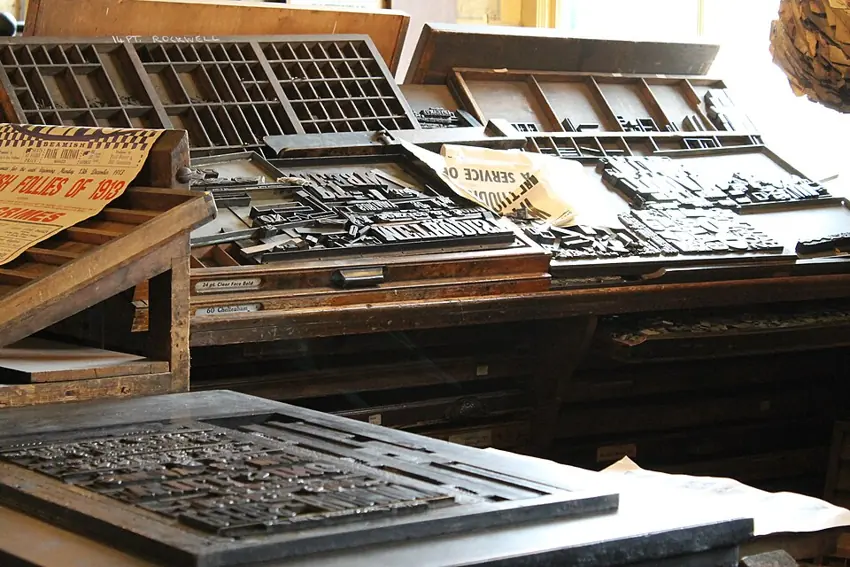
A matrix and hand mould form reusable metal sorts. Compositors select the letters, assemble lines in a composing stick and lock a page into a forme. These are preparation processes, not printing presses.
A trial impression exposes errors before a run. The proofreader checks text and layout; the compositor corrects the forme. Ink distribution and impression are checked at the press.
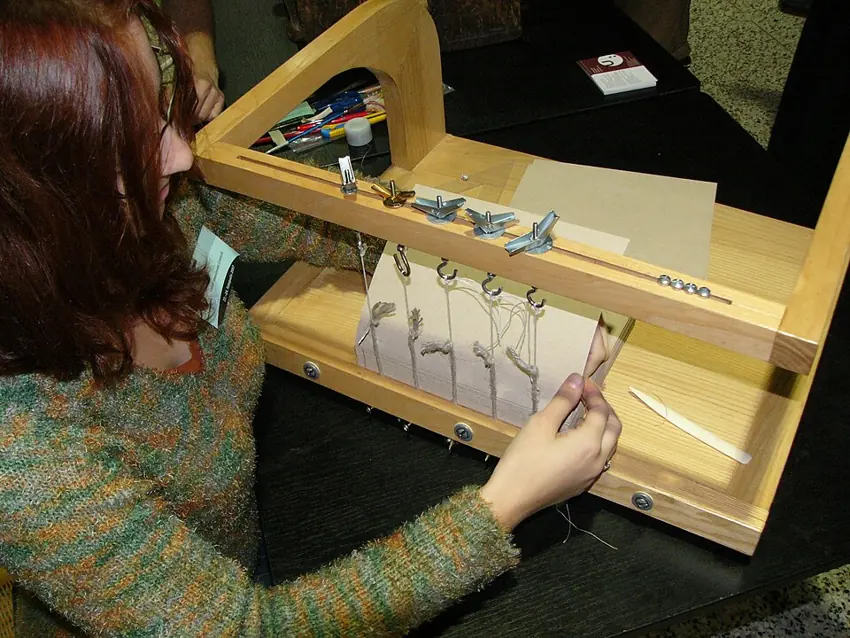
Folded sections are gathered in order and sewn on supports. A binding press holds or compresses the book block during finishing. Its pressure serves book construction rather than transferring ink.
A clamp holds the stack as a guided blade trims its edge. Trimming follows the required finishing sequence; checked books then move to storage and dispatch. The virtual blade motion illustrates the mechanism.
Munshi Newal Kishore (1836–1895) founded the Press in Lucknow in 1858. It became a major publishing enterprise, bringing together work in Hindi, Urdu, Persian, Arabic and Sanskrit.
The legacy page on the earlier Le Press website describes a commitment to literary diversity and cultural exchange. This museum carries that story forward and reconnects its links to digital books.
Heidelberg University Library records approximately 5,000 titles published during the founder's lifetime, across subjects including literature, education, religion and medicine.
Poets, storytellers and scholars brought writing into the world of publication. Watch manuscripts arrive, a greeting unfold and a discussion begin: the author, the publisher and the promise of a new book.
Premchand and Madhuri
Premchand worked as an editor of Madhuri in Lucknow in the 1920s and early 1930s. This later editorial chapter carries the founder’s publishing legacy forward.
A place for many languages. A route from manuscript to reader. A publishing legacy continued by later generations.
Museum interpretation, not quotations by Munshi Newal Kishore. No authenticated source for his personal sayings has yet been established for this exhibit.
Look closer · The craft behind the book
Machines, hands and printed pages.
Reference photographs from other collections help explain the work represented in the model. They are not photographs of the former Le Press operation.
An historic platen press
A 1970 Heidelberg platen press in the Deutsches Museum, Munich. Reference image; not equipment identified at Le Press.
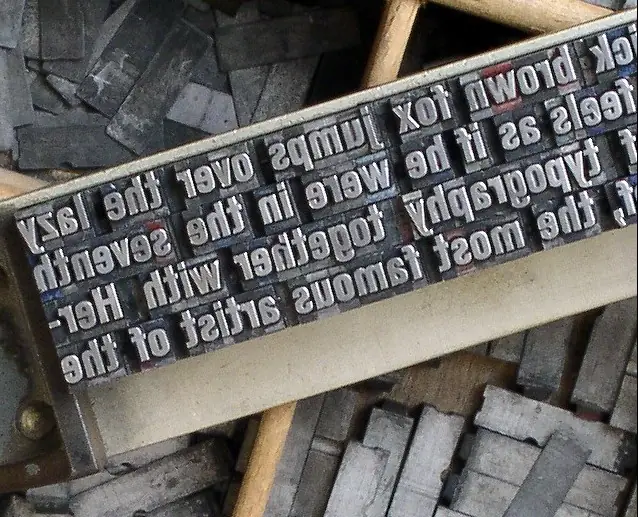
Individual metal sorts assembled in a composing stick. Lead-based type alloys made reusable letters possible; the exact alloy in this photograph is not specified.
“Gutenbergs Enkel” follows setting, printing and binding. This German-language reference film opens in Wikimedia Commons with its source and licence information.
Explore the Urdu and Persian manuscript sections and the editorial work behind Awadh Akhbar. Then move forward in time to the Madhuri magazine office, shown as a later chapter in the Press’s life.
Type casting→ Composition→ Printing→ Finishing & storage→ Dispatch→ Reader
This trail interprets movable-type production. The Press also used lithography: a different process that reproduced writing and images from a prepared surface. A single machine model cannot represent every technique or period of its long history.
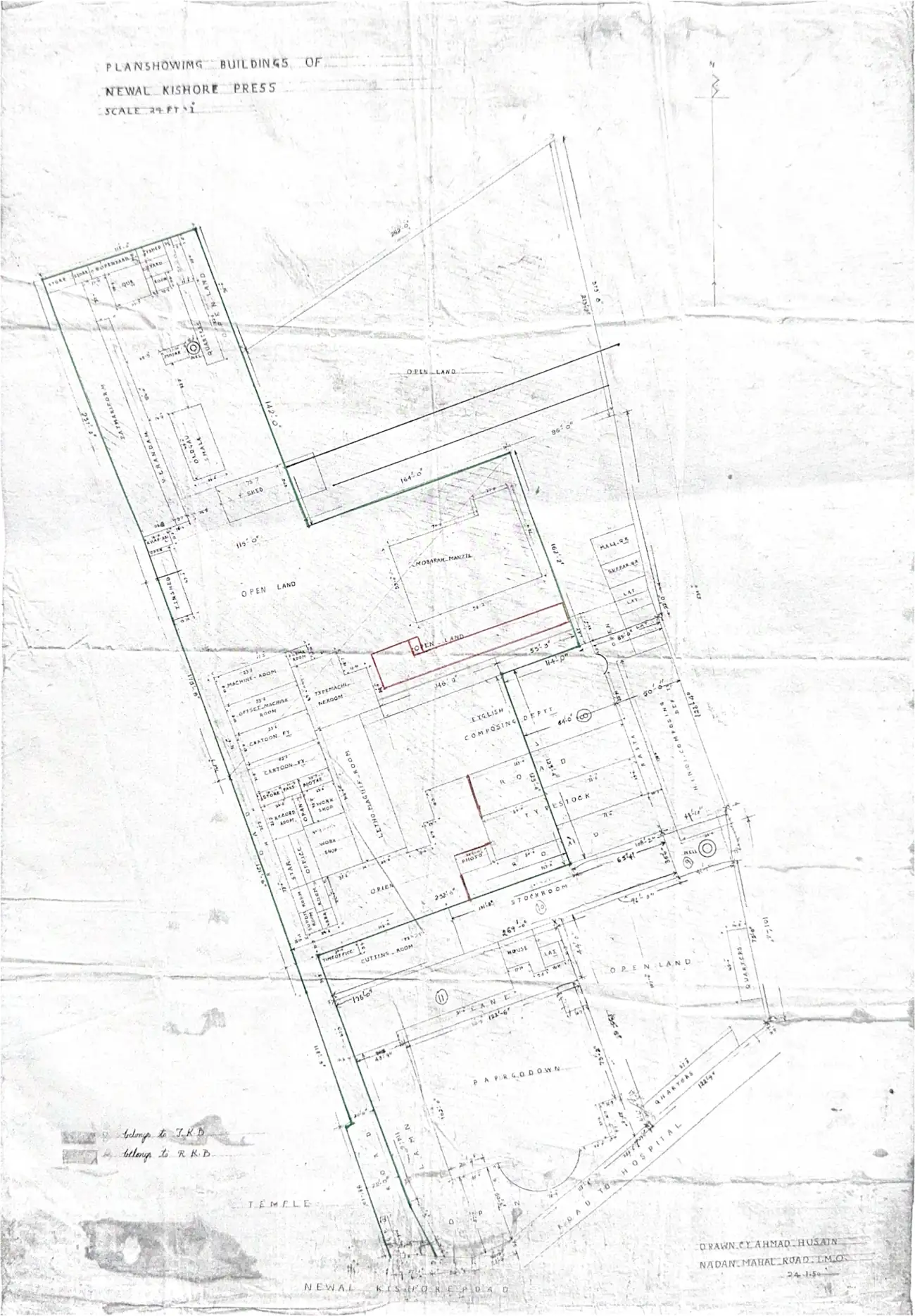
The supplied historic drawings name functions that ordinary architectural views can hide: machine rooms, English composing, type stock, workshops, cutting and paper storage.
These labels make the campus legible as a connected workplace. The estate account adds memories of the Hindi section, books godown, mail office and casting work beside the chimney.
Displayed source: “Le Press Old Map.pdf”, estate-supplied scan. Three further supplied scans were reviewed, including an annotated blue plan. Coloured boundary markings are archival annotations; this museum does not interpret ownership or legal boundaries.
Explore the wider collection of digitised books on Internet Archive. Open a volume to inspect its original printed pages, publication details and available reading or download formats. The selected editions below offer a starting point; this collection opens the larger publishing legacy.
Do you hold a photograph, a printed book, a machine record or a memory of working at the Press? Share an account with the Le Press team so that future exhibits can become more specific and more complete.
Follow the printing process in text, from manuscript to finished book.
Big barn · letterpress printing
Welcome to Le Press, where Lucknow’s publishing heritage comes alive. In eighteen fifty-eight, Munshi Newal Kishore founded a remarkable house of literature and learning. Here in the printing hall, ink, metal type and skilled hands turned manuscripts into books. The rhythm of the letterpress carried ideas towards new readers.
Letterpress gallery
Every impression began with precision. Raised letters received ink, paper met the printing surface, and pressure brought a page to life. Watch the hand press rise and fall. Behind this simple movement stood the patience of the printer and the promise of a book waiting to be read.
Hand composition
A book began one letter at a time. Compositors selected metal sorts, assembled lines and built pages with extraordinary care. Their knowledge lived in their hands as much as in the type cases. This skilled work gave writers’ ideas a clear, enduring form.
Hindi composition
Hindi publishing opened a rich world of language, learning and storytelling. Devanagari composition demanded a practised eye and careful arrangement. At Newal Kishore Press, that craft helped carry literature, education and knowledge into printed pages, connecting authors with generations of readers.
English composition
The English composing department formed another part of this multilingual enterprise. Compositors arranged the text; readers checked each proof. Across different scripts, the aim remained constant: a well-prepared page and a publication ready to serve its readers.
Urdu section · writing & composition
Urdu gave voice to a vibrant world of poetry, news and storytelling. Newal Kishore Press became a major home for this literary culture. Calligraphers, editors and printers brought their skills together, while lithography helped preserve the flowing character of handwritten text on the printed page.
Farsi section · Persian publishing
Persian connected readers with a vast inheritance of poetry and scholarship. Newal Kishore Press helped sustain that inheritance through publication. Manuscripts passed through careful reading and preparation, carrying the beauty and knowledge of Farsi into books that could travel beyond the writer’s desk.
Proofreading & page preparation
The proofreader guarded the quality of the page. A misplaced letter, a missing word, a line needing correction: every detail mattered. Editors and compositors worked together to refine the text. Their quiet discipline stood behind the authority and usefulness of the finished book.
Folding, sewing & binding
Now the printed sheets become a book. Folding establishes the sections, gathering puts them in order, and sewing joins them into a lasting whole. The binder’s craft protects the writer’s words. These hands gave printed knowledge a form that readers could hold, carry and keep.
Cutting & packing
A finished book deserves a careful finish. Trimming gives its pages a clean edge; checking and packing prepare it for the journey ahead. This final care connects the craftsmanship of the workshop with the experience of the reader opening a new publication.
Paper godown
Paper was the foundation of the entire enterprise. Before ink touched a sheet, it had to be received, stored and prepared for printing. The paper godown supported the daily work of the presses, turning a supply of raw material into the possibility of thousands of pages.
Books godown
Here the work of many hands comes together. Finished volumes wait for their readers: literature, learning, religion and medicine. Heidelberg University Library records approximately five thousand titles published during the founder’s lifetime. That extraordinary range reveals the scale of Newal Kishore’s publishing achievement.
Finished books · packing & dispatch
A press fulfils its purpose when its books reach people. In the mail and dispatch office, orders became parcels and addresses became destinations. From these practical routines emerged a wider circulation of ideas, connecting the labour of Lucknow’s printing rooms with readers beyond the campus.
Chimney courtyard · type foundry
The chimney courtyard recalls a powerful part of the estate’s working memory: casting metal type. Small reusable letters made repeated impressions possible. From the type founder’s bench to the composing room and press, material skill served the larger ambition of spreading literature and learning.
Awadh Akhbar · newspaper office
Awadh Akhbar carried the energy of journalism into the publishing house. News, correspondence and editorial judgement came together in Urdu print. The newsroom connected the press with public life, giving current events a place alongside the books and scholarship produced across the estate.
Madhuri · magazine editorial office
The story continued into the twentieth century with Madhuri, the Hindi literary magazine. Munshi Premchand worked as one of its editors in Lucknow. Submitted writing, editorial discussion and carefully corrected proofs sustained a new chapter of literary life, carrying the Press’s publishing legacy into another generation.
Editorial & accounts
Publishing administration is distributed across the campus. Editorial desks and manuscript records occupy the west offices, while translation, subscriptions and correspondence occupy the east rooms. Clear approaches connect the offices to production and the finished-book store.
Publication archive & reading
A printed book can outlive the world that made it. Today, digitised Newal Kishore Press publications invite us to encounter that inheritance directly. Open the reading-room collections, explore their languages and discover the pages. This living archive keeps Lucknow’s publishing memory in conversation with the present.
Maintenance workshop
The workshop kept the printing world moving. Tools, adjustments and repairs supported every working day. Remember the mechanics, compositors, printers, binders, editors and clerks whose combined skill gave this press its strength. At Le Press, their achievement remains part of Lucknow’s living cultural inheritance.
West wing · cylinder press room
The west press room extends the working rhythm of the great publishing house. Watch the cylinder, rollers, flywheel and reciprocating type bed. Printers feed and receive the sheets while a central aisle connects the workstations. Every machine serves the journey from manuscript to reader.
Timber hand-press gallery
The timber press makes the principle of letterpress visible. Ink rests on raised type. Paper is held in a hinged frame, brought over the type, and pressed by a screw-driven platen. Strong timber uprights resist the pressure. The printer releases the screw and lifts a freshly printed page.
Stone lithography workshop
Lithography gave flowing handwriting a powerful route into print. The image is drawn on limestone with a greasy medium. Prepared blank areas hold water and repel oily ink, while the image accepts it. The stone bed travels beneath the scraper to make an impression. Calligraphy, preparation and skilled printing work together.
Engraving & intaglio
In this workshop, the engraver cuts fine lines into a copper plate with a burin. Ink fills the incised lines, while the surface is wiped clean. Damp paper passes with the plate between pressure rollers, lifting the image from the grooves. This is intaglio, a different process from raised-type letterpress and flat-surface lithography.
Printing ink & dye store
Colour begins with careful preparation. Here the virtual press keeps printing inks, colour materials and mixing tools together, apart from the paper and finished books. Labelled containers and a weighing bench make the work legible. The store supplies printers with the materials that bring words and images to life.
Print drying & inspection
A printed sheet needs care before it becomes a book. Racks hold the impressions apart while the ink dries. At the inspection table, workers check the clarity of type, the strength of the image and the quality of the sheet. Approved work proceeds to folding, binding and the finished-book store.
Manuscript receiving
Manuscripts enter a world of careful reading, registration and publishing decisions. This west-wing office holds the receiving desk and manuscript register, giving visiting writers a place before their pages enter production.
Subscriptions & correspondence
Subscriptions and correspondence connect the press with its readers. Clerks maintain orders, accounts and letters in dedicated east-wing offices, while packed books leave through the finished-book store and dispatch department.
Translation & publishing office
Language specialists and publishing clerks prepare texts for a multilingual readership. The east wing brings translation desks and publication records together beside a proof press.
THE CFCPD MANIFESTO · GAURAV VATSA
Living heritage. A digital future.
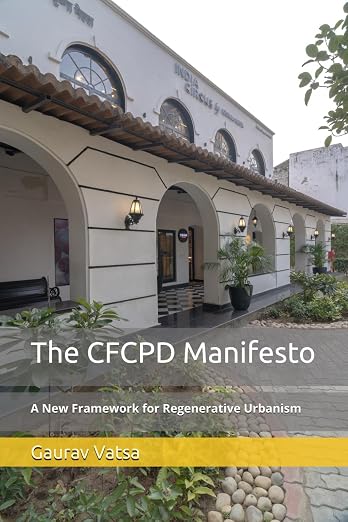
The CFCPD Manifesto Gaurav Vatsa
Le Press is a metaverse-enabled heritage destination in Hazratganj, Lucknow. Its browser-based 3D campus, Newal Kishore Press Virtual Museum and QR-enabled collectibles connect the physical place with an interactive digital experience.
This vision puts The CFCPD Manifesto: Culture, Finance, Community, Planet, Digital — A New Framework for Regenerative Urbanism into practice. Written by Gaurav Vatsa, the architect of the Le Press development, the book connects five dimensions of a place’s continuing life.
Culture: preserve the printing legacy and open its stories to new audiences.
Finance: give restored buildings useful commercial life and local enterprises a platform.
Community: bring visitors, makers and readers together.
Planet: extend the life of existing buildings and explore climate-conscious design.
Digital: make heritage accessible through virtual tours, archival reading and playful discovery.