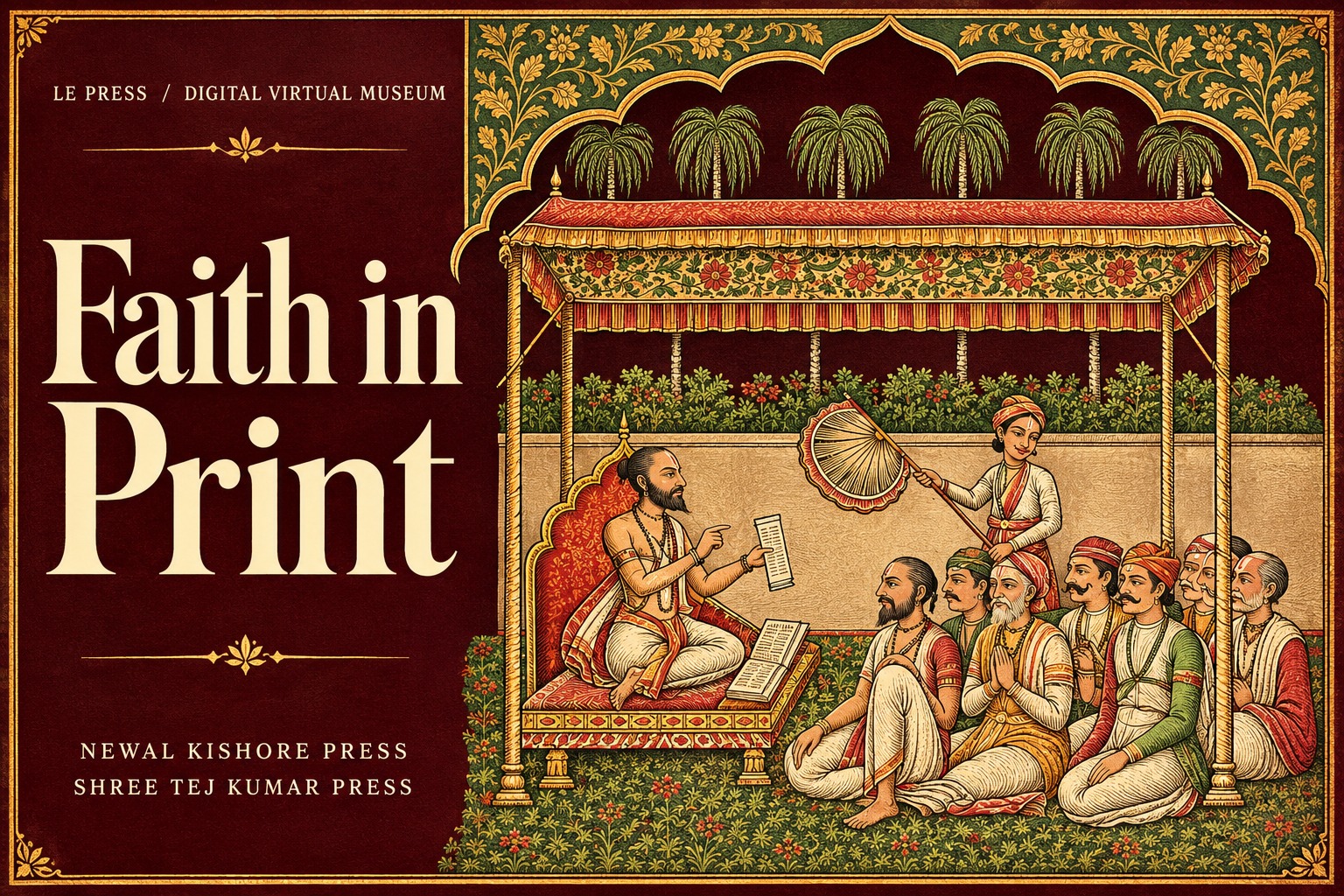
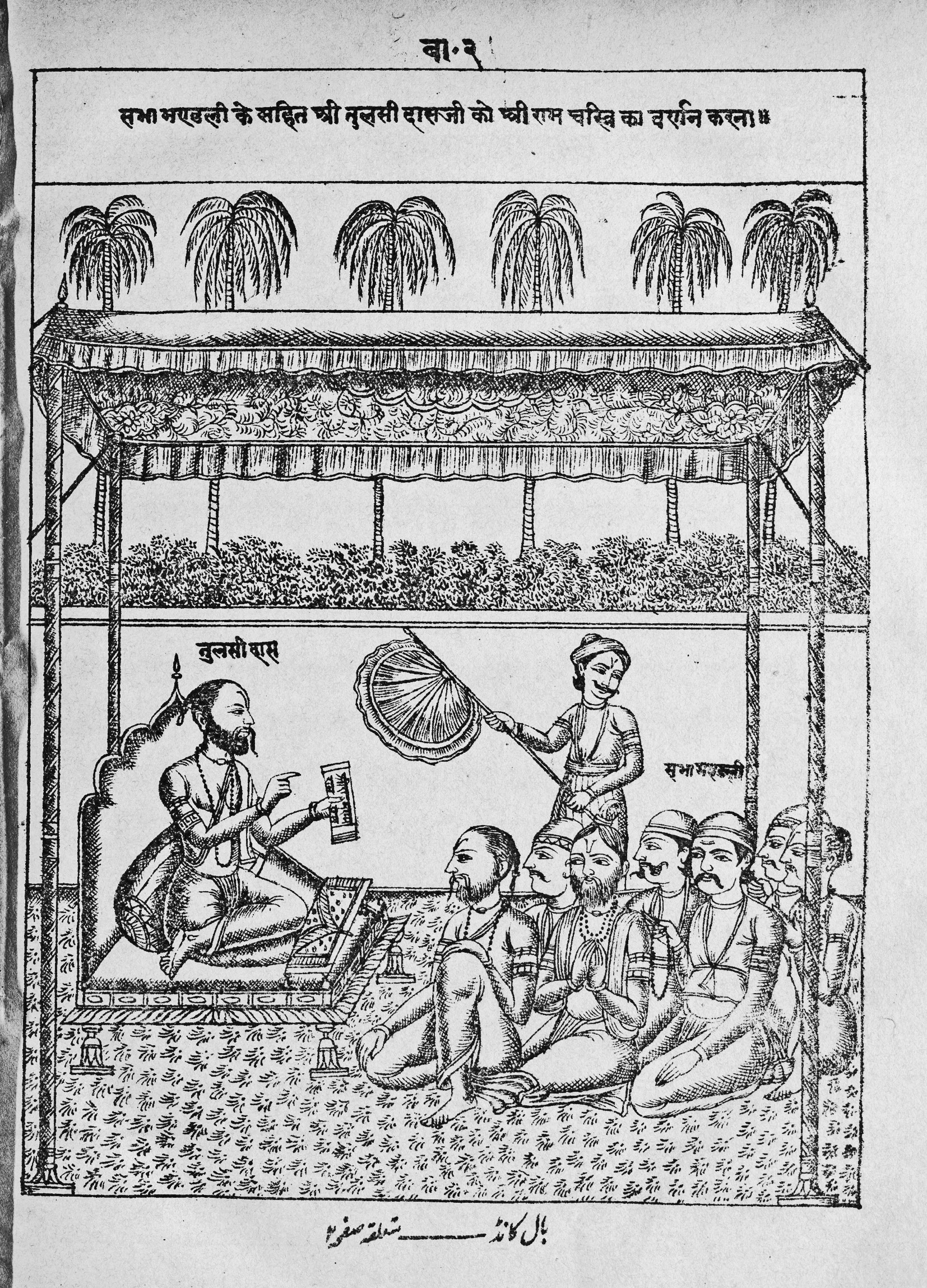
A book held up to the light
Under a flowered canopy, Tulsidas holds a small manuscript upright. With his other hand he points to the page. A group sits facing him, and behind the listeners an attendant holds a fan. When Munshi Newal Kishore’s Lucknow press printed this picture in an 1882 Ramcharitmanas, it gave a place in the book to people who might never have held a copy. They could still sit close and hear Rama’s story.
Munshi Newal Kishore founded his press in Lucknow in 1858. Tulsidas’s Awadhi verses already had a life in recitation. The printer’s part was to put another copy into the hands of the person who would read them aloud. Turn from the canopy to the attack on Kumbhakarna in the same edition. The giant towers over his attackers. Monkeys raise boulders. Someone listening to the battle could find the giant with a finger on the picture.
The Gita in a reader’s own hand
In 1884 the house issued a Bhagavad Gita with an Urdu translation by Munshi Shyam Sunder Lal. Look at its yellow wrapper. Above, the title sweeps across the page in the Perso-Arabic script used for Urdu. Below, Bhagavad Gita appears again in Devanagari. Someone picking it up could recognise the book from either end of that arrangement. A copy preserved at the Khuda Bakhsh Library in Patna runs to 412 pages.
There was a practical reason to offer that choice. Nineteenth-century Lucknow was a centre of Urdu poetry. In the neighbouring North-Western Provinces, Urdu in Persian script also took on the work of the colonial courts after Persian ceased to be their official language. A reader who used Urdu for a petition or a poem could use it to follow Arjuna’s questions to Krishna. The press allowed a Hindu scripture and a familiar habit of reading to meet on the same page.
“The work is yours to do. Its fruits are never yours to claim.”
A second book for eight annas
At the back of a 1934 Brihadaranyaka Upanishad, a reader came to two narrow columns of titles and prices. For half a rupee, one could choose between two Upanishads. The two Gitas on the same list cost more. At the foot of the page was the address of the manager of Newal Kishore Press in Lucknow.
That little advertisement lets us stand at the bookseller’s counter. A reader could choose a work to suit a particular sum and knew where to ask for it. The Upanishad containing the list cost three rupees. Its title page records a third printing of a thousand copies. Those figures give substance to the work of keeping sacred literature available, from the price of the next book to the number of fresh copies the press was prepared to supply.
Explore the sources
Lucknow, 1934
| Book | Listed price |
|---|---|
| Prashna Upanishad | 8 annas |
| Mundaka Upanishad | 8 annas |
| Ashtavakra Gita | 1 rupee 8 annas |
| Bhagavad Gita | 2 rupees 8 annas |
The names in Hanuman’s hand
Shree Tej Kumar Bhargava’s name appears on a 1954 Lucknow edition of Valmiki’s Ramayana in Urdu. Beneath a tree, Hanuman offers something to the captive Sita. At first glance, his hand seems almost empty. The Urdu caption tells the reader to look for Rama’s ring. Sita knows whose messenger stands before her because she remembers the person to whom that small possession belongs.
In 1969 Shree Tej Kumar Press printed Shri Bhaktamal, a work about devotees. Its title leaf identifies Tejkumar Press and Book Depot as successor to Navalkishore Press and Book Depot. Beside the date the press recorded a fifth printing of 3,000 copies. Murlidhar Mishra is named as the printer. A century-long inheritance comes into focus through one person’s credit for the work.
On the illustrated opening, Hanuman kneels on a petalled pedestal. One palm is raised. In the other hand he holds up the names of Sita and Rama. Look back to Tulsidas under his canopy, holding his manuscript out to the listeners. Eighty-seven years separate those two printed gestures. In each, somebody has turned the words outward so that another person can read.