
First published on the Le Press Hazratganj blog. Preserved here with its original date and text; references to venues, events and plans reflect the time of publication.
Education and Knowledge Dissemination
The press catered to a broad spectrum of audiences, from scholars and educational institutions to lay readers. It provided affordable access to high-quality editions of texts, thereby democratizing education.
Preserving Secular and Religious Harmony
By publishing texts from Hinduism, Islam, and secular traditions alike, the Newal Kishore Press became a symbol of India’s composite cultural ethos, often referred to as the Ganga-Jamuni tehzeeb.
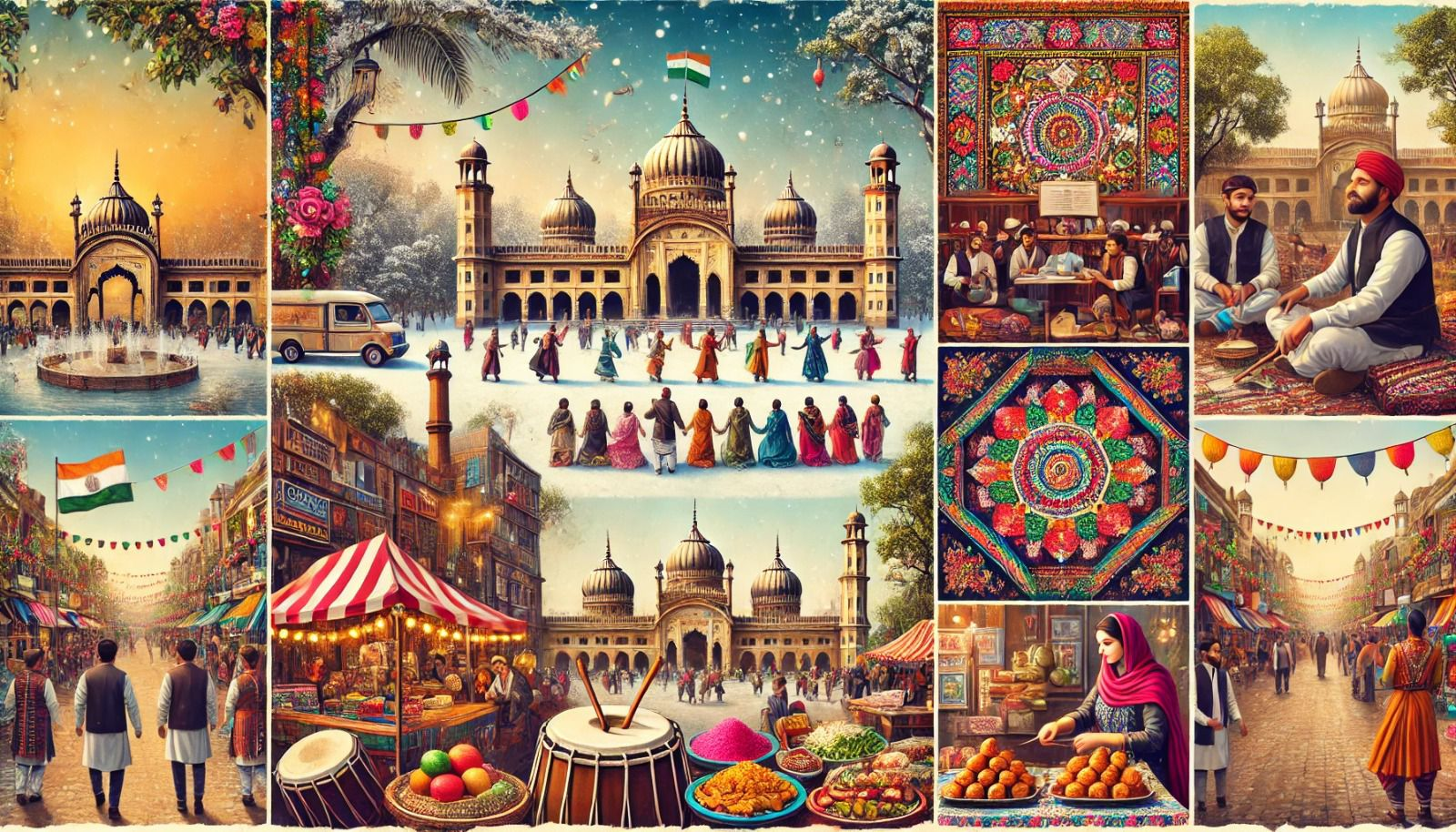
The Press as a Catalyst for India’s Literary Heritage
Reviving Ancient Texts
The Newal Kishore Press spearheaded efforts to revive and preserve ancient Indian texts.
Valmiki’s Ramayana and Vyasa’s Mahabharata, in meticulously edited Sanskrit editions, found their way to scholars and lay readers.
Religious and philosophical texts like the Bhagavad Gita, Upanishads, and Manusmriti were published alongside Islamic masterpieces like the Quran, Hadith, and Tafsir al-Jalalayn.
This inclusivity underscored the press’s commitment to India’s cultural synthesis, where Hindu, Muslim, and secular traditions coexisted harmoniously.
Shaping the Urdu Literary Tradition
Urdu literature owes much of its flourishing to the Newal Kishore Press.
The press became an early publisher of Mirza Ghalib, immortalizing his works for generations.
Amir Khusro, the pioneer of Hindavi-Urdu poetry, saw his legacy revitalized.
Munshi Premchand, one of India’s greatest writers, published his early Urdu works here before transitioning to Hindi.
By providing an enduring platform, the press became synonymous with Urdu’s evolution as a literary and cultural language.
Icons of Comparative Thought
One of the most significant contributions was the publication of Dabistan-i-Mazahib, a Persian masterpiece that examined religious traditions. Its impartial exploration of Hinduism, Islam, Christianity, and other faiths became a cornerstone for India’s intellectual and cultural pluralism.
Fatawa-e-Alamgiri, a voluminous work on Islamic law commissioned by Emperor Aurangzeb, was printed in an affordable edition, making it accessible to students and scholars.
These works reinforced the press’s identity as a crucible of secular thought and interfaith dialogue.
Stories Behind the Masterpieces
A Ghalib Revival
In the aftermath of the 1857 revolt, Mirza Ghalib struggled financially and emotionally. His poetry, often dismissed as elitist, found a home at the Newal Kishore Press. By publishing Diwan-e-Ghalib, the press ensured that his verses reached a wider audience, cementing his place as an icon of Indian poetry.
The Rediscovery of Tulsidas
Tulsidas’s Ramcharitmanas, often referred to as the soul of Indian folklore, gained mass popularity through affordable editions published by the press. These editions bridged the gap between oral and written traditions, bringing the epic closer to common households.
Munshi Premchand: A Dual Legacy
Premchand’s Urdu stories like Soz-e-Watan found their first readers through Newal Kishore’s publications. His works, often blending the struggles of rural India with universal themes of justice and humanity, showcased the confluence of Hindi and Urdu traditions.
Advancing Education and Scholarship
The Newal Kishore Press played a critical role in the intellectual life of colonial India. It supplied textbooks to schools and universities, democratized access to rare manuscripts, and supported the rise of modern Indian historiography.
Its reputation spread beyond India, with scholars from Europe and the Middle East acknowledging its role in preserving invaluable texts. Institutions like Oxford and Cambridge libraries still house original Newal Kishore editions in their collections.
Symbol of India’s Composite Culture
The press became a living embodiment of India’s Ganga-Jamuni tehzeeb, a cultural ethos where Hindu and Muslim traditions coalesce seamlessly. By publishing works from varied traditions, it fostered mutual respect and understanding.
At a time when communal tensions threatened to fragment society, the Newal Kishore Press stood as a reminder of India’s inherent pluralism.
Legacy and Lessons for Today
The Newal Kishore Press continues to inspire writers, publishers, and cultural historians. Its contributions remind us that literature is a powerful medium for unity, capable of transcending time and boundaries.
In a world increasingly divided by identities, the legacy of the Newal Kishore Press serves as a call to rediscover our shared heritage and embrace the ideals of coexistence and harmony.
Conclusion
The Newal Kishore Press was not merely a publishing house—it was a cultural movement that championed India’s rich diversity. From ancient Sanskrit scriptures to the evocative verses of Urdu poets, it brought together the voices that define our shared history.
By celebrating its contributions, we honor the enduring power of literature to bridge divides and build a more inclusive world.