
First published on the Le Press Hazratganj blog. Preserved here with its original date and text; references to venues, events and plans reflect the time of publication.
The Newal Kishore Press, founded by Munshi Newal Kishore in 1858, became one of the most influential printing presses in India, particularly in the context of the intellectual undercurrents that helped fuel India’s struggle for independence. While the press was not directly involved in armed resistance, it played a significant role in the development of nationalist ideas, the promotion of vernacular literature, and the dissemination of revolutionary thoughts. Its work helped to cultivate the intellectual foundation upon which the freedom movement was built.
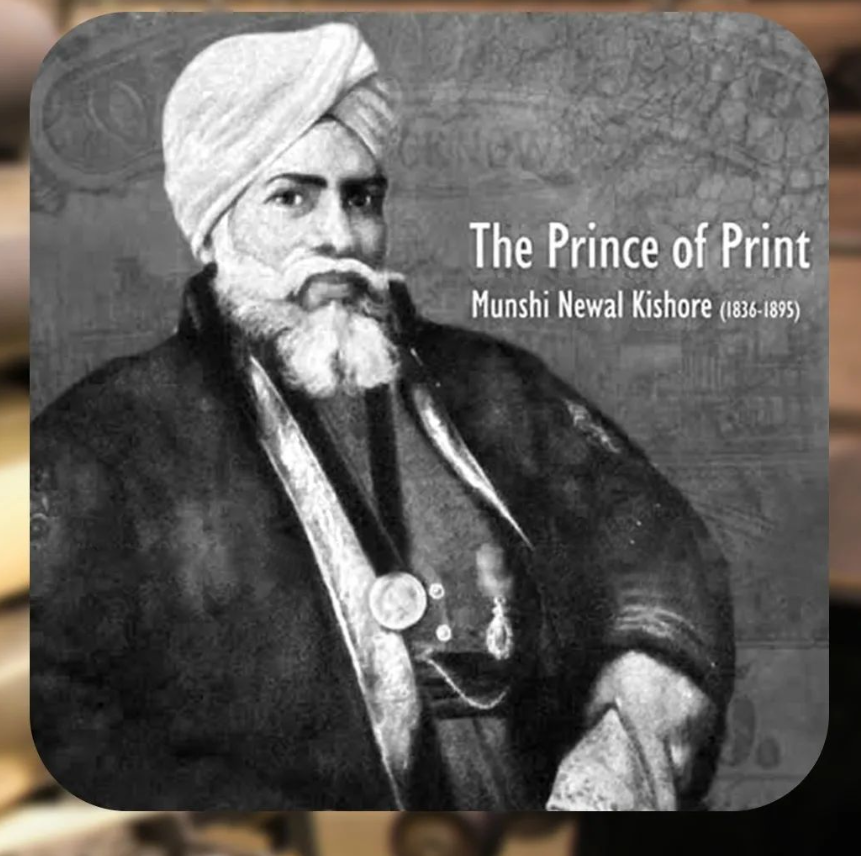
1. Promoting Nationalist Thought through Print Media
Munshi Newal Kishore understood the power of the written word in shaping public opinion. His press became a key site for the publication of nationalist literature and revolutionary texts, which sparked critical dialogue on Indian independence. The press's printed material ranged from works of social reform to radical political literature that critiqued British colonial rule.
Publishing Nationalist Literature and Revolutionary Works: The Newal Kishore Press played a role in circulating the ideas of many prominent nationalist leaders. One of the most significant works printed was "Hind Swaraj" by Mahatma Gandhi, a pamphlet that articulated a critique of British colonialism and proposed a vision for self-rule (Swaraj). In this work, Gandhi advocated for non-violent resistance and rural self-sufficiency as opposed to industrialization under British rule.
Excerpt from Hind Swaraj (1909):
"I believe that the civilization into which I was born and in which I live is the best civilization. I do not want the civilization which is based on the discovery of gold and silver. The civilization which has led to the degradation of the human soul I do not want... I want a life of simplicity, of independence, of self-sufficiency, and I want it for my countrymen."
The publication of such works made ideas of self-rule accessible to a broad audience and connected the intellectual elite with the masses who were beginning to demand their independence from the British.
Promoting Social Reform and Political Awareness: The press also supported books and pamphlets that dealt with social reforms in India, including the abolition of practices like Sati, the promotion of female education, and the reform of the caste system. It printed works by reformers such as Raja Ram Mohan Roy, who famously campaigned for the abolition of Sati (the practice of a widow self-immolating on her husband’s funeral pyre), and Ishwar Chandra Vidyasagar, a key advocate for women’s education and the rights of women in colonial India.
Excerpt from Raja Ram Mohan Roy’s Writings on Sati:
"The practice of Sati is a violation of the law of nature and the sacred texts of Hinduism. It is a heinous act, perpetuated by custom and ignorance, and must be abolished for the well-being of society."
These works, published and disseminated by the Newal Kishore Press, helped awaken a collective sense of social justice and sparked reforms across India, which were crucial to the broader nationalist movement that sought to not only free India from colonial rule but also to build a more just and equitable society.
2. Promotion of Hindi and National Identity
One of the enduring legacies of Munshi Newal Kishore and his press was the promotion of the Hindi language, which was a critical part of the rise of a unified national identity. Prior to the 19th century, most literary and intellectual work in India was conducted in Persian and English, with vernacular languages like Hindi and Urdu being relegated to the lower classes. Newal Kishore Press sought to challenge this hierarchy by publishing in Hindi and ensuring that the masses could access literature in their own language.
Reviving Hindi Literature and Nationalism: Newal Kishore was not just printing books; he was fostering a cultural renaissance in Hindi. His press published translations of works that were important in building nationalist sentiment. For example, it printed works like "The Ramayana" and "Mahabharata", which were seen not only as sacred texts but as symbols of India's ancient civilizational pride. These texts were reinterpreted with a nationalist lens that emphasized India’s contributions to world culture and its deep philosophical roots, promoting pride in Indian heritage.
Excerpt from a Hindi Translation of the Mahabharata (by Newal Kishore Press):
"India is a land where wisdom, courage, and dharma (righteousness) have always prevailed. The Pandavas fought not just for land, but for justice, for dharma. This is the legacy of our ancestors and it is our duty to uphold this tradition against foreign oppression."
Strengthening Cultural Unity through Language: By championing Hindi, Newal Kishore Press helped create a sense of shared identity among the people of northern India. The press’s works were instrumental in spreading a unified sense of national consciousness at a time when linguistic differences could have fragmented the emerging nationalist movement.
3. Providing a Platform for Local Voices and Social Movements
The Newal Kishore Press was a platform for regional intellectuals and reformers who had a vision for India that extended beyond colonial domination. It became a meeting point for diverse ideas and helped to amplify voices that may have otherwise remained unheard.
Publishing Revolutionary Works: The press printed books and pamphlets that were often revolutionary in nature. It was known to publish works by thinkers and activists who were pushing for more direct forms of resistance against the British. The works of Subhas Chandra Bose and Bipin Chandra Pal were influential in shaping the discourse around armed resistance and civil disobedience. Though the press itself did not advocate violence, it provided the intellectual infrastructure for the revolutionary ideas of the time.
Excerpt from Subhas Chandra Bose's Writings (published by Newal Kishore Press):
"We must fight for the freedom of our country with all our might. The British have kept us under their heel for too long, and it is our duty to rise and reclaim our land. The time for peaceful negotiation has passed; we must take up arms and fight for our independence."
4. Contribution to the Swadeshi Movement and Nationalist Unity
Newal Kishore Press was instrumental in fostering the Swadeshi Movement, which aimed to boycott British goods and revive Indian industries. The press published pamphlets and articles that encouraged Indians to use indigenous products and supported the production of goods that were in direct competition with British imports.
Support for Indigenous Industries: The press printed materials that highlighted the importance of supporting local artisans and industries, thus contributing to the larger economic framework of the nationalist movement. This advocacy helped promote self-reliance, a core principle that became central to the independence movement.
Excerpt from a pamphlet promoting Swadeshi:
"When we buy British goods, we are supporting the British Empire and feeding their greed. It is time for us to revive our own industries, produce what we need, and take pride in the products of our own land. Let us all unite under the banner of Swadeshi."
5. Legacy and Lasting Impact
The contributions of the Newal Kishore Press were integral to the intellectual and cultural awakening that led to India’s independence. By printing books that promoted nationalism, social reform, linguistic pride, and revolutionary thought, the press helped lay the groundwork for the intellectual revolution that would ultimately challenge and overthrow British colonial rule.
The press’s contributions to Hindi literature and national unity continue to be acknowledged as vital aspects of the broader freedom struggle. Its legacy is not just in the texts it produced, but in its role as a medium through which the voices of India’s intellectual and revolutionary leaders could reach the masses, mobilizing them for the cause of independence.
Today, the Newal Kishore Press stands as a symbol of intellectual resistance, a testament to the power of the written word in shaping a nation's destiny and contributing to the liberation of a country from colonial oppression.