The first Indian life in the 1911 directory belongs to a man whose reign was barely three months old. Mir Osman Ali Khan had succeeded his father as Nizam of Hyderabad on 29 August. The compiler could give his titles and reproduce part of his installation address, yet acknowledged that little was known of the new ruler’s personality. Several pages of family history follow. At the head of a book devoted to eminent people stands a young man whose public life had scarcely begun.
That difference between what a publisher could establish and what readers wanted to know runs through Who’s Who in India. In Lucknow, Rai Bahadur Prag Narain Bhargava had only a few months to bring out an English directory for the Delhi Coronation Durbar. Among the lives he assembled were a ruler responsible for a flour mill, a doctor measuring schoolchildren’s eyesight and a lawyer who once waited at a Red Sea port for the fare to London. Each has something to tell us about how people moved, worked and came to public notice in 1911.
The Urdu book behind the English one
Read “The Newul Kishore Press” in full ↗ · Both original leaves of the publishing house’s 1911 article and the accompanying family plate.
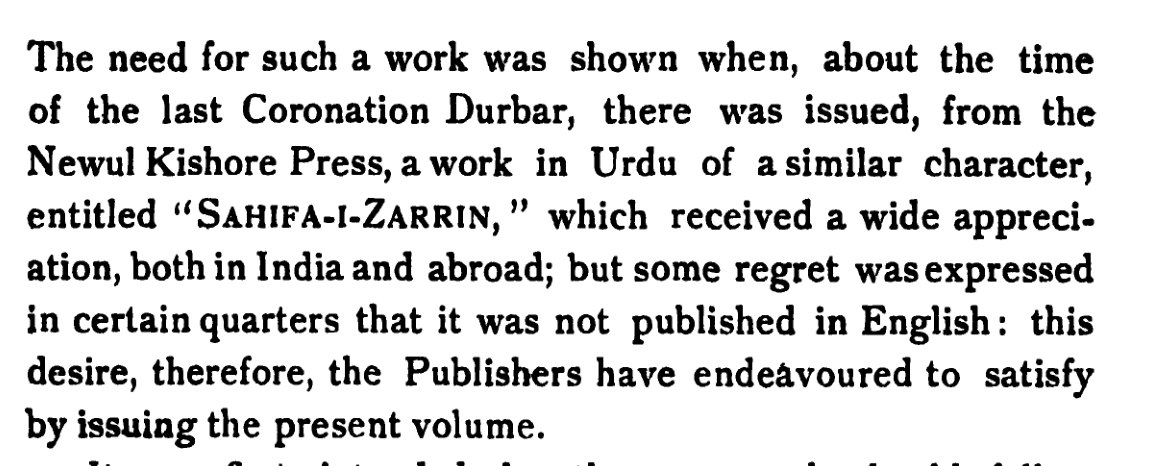
Bhargava signed his preface in Lucknow on 1 December 1911. He traced the English book to an earlier experiment at the family press. Around the previous Delhi Durbar, it had issued an Urdu work called Sahifa-i-Zarrin. A surviving copy from the Rampur Raza Library is catalogued under the title Saheefa-e-Zarrin, with the date 1902. Readers had asked why the work had never appeared in English. When the Press took up that request in July 1911, it set out to enlarge the earlier book and bring the lives up to date.
The preface lets a visitor follow a biography into type. The Press sent prospectuses to people it considered distinguished. It consulted published reference works and received information from individuals. Some replies reached Lucknow so late that entries already in the printers’ hands had to be called back. Bhargava asked readers to send corrections, especially to the spelling of names. A misspelt family name could defeat the very purpose of the index. The corrections issued the following June show how long the work of identifying people continued after the books left the press.
The business of governing Bhopal
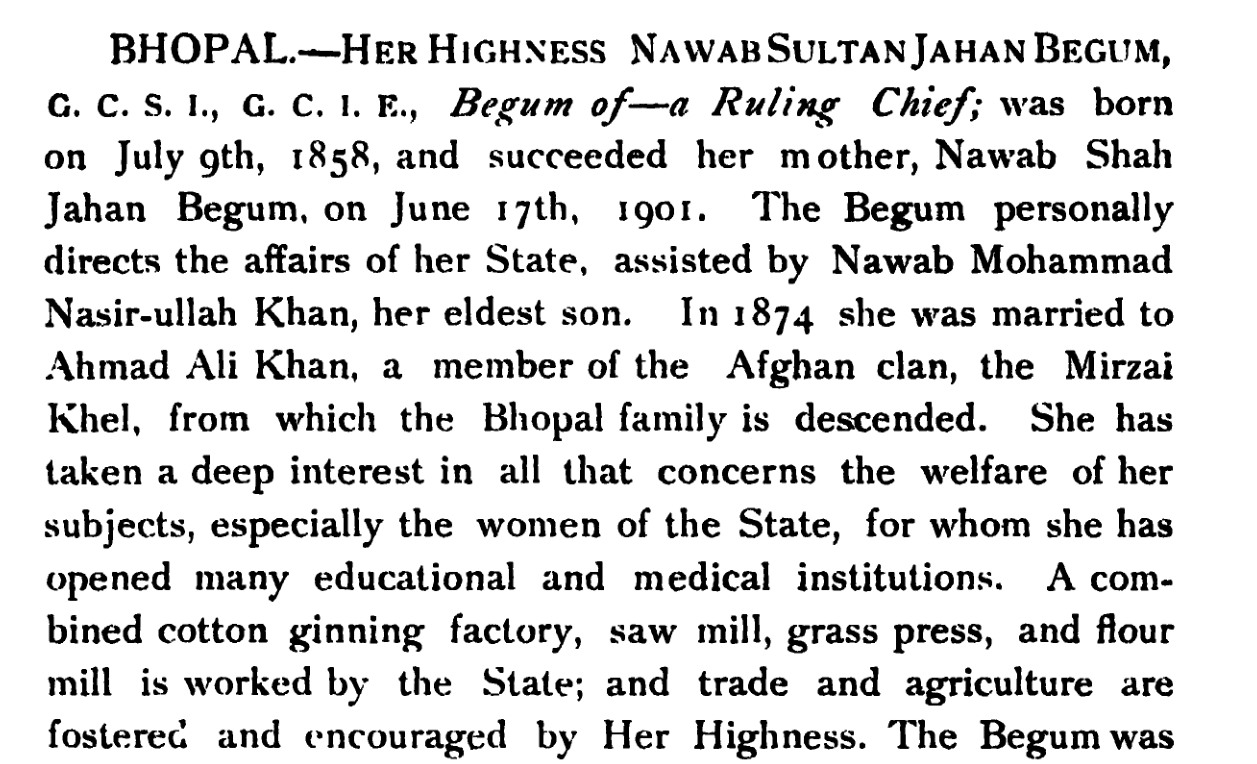
Sultan Jahan Begum of Bhopal appears under the Central India Agency. The first sentences establish who held power. She had succeeded her mother, Shah Jahan Begum, in 1901 and personally directed the affairs of state. Her eldest son assisted her. A reader encountering the word Begum as a courtly title can see here precisely what authority this particular woman exercised.
The notice records educational and medical institutions she opened for women, then turns to a state undertaking that combined a cotton gin, sawmill, grass press and flour mill. The four trades occupy less than a sentence. They are worth reading slowly. Cotton had to be separated from its seeds, timber sawn and grain ground. Such everyday work entered this record because the state ran the machinery. The directory preserves the ruler’s name and the uses of the mill. The names of the people who worked there would have to be sought in other records.
An eye test in a schoolroom
Farther on in the same part, the heading changes from ruling houses to the officials who served in the states. Page 151 introduces Dr S. V. Ramaswamy Iyengar of Bangalore. He trained in Madras and gained medical qualifications in Edinburgh and Glasgow. His appointments took him from hospital work into the Maharani’s Girls’ School as a science teacher, back to the city hospital, and subsequently into an eye infirmary.
In 1901 he travelled through India gathering statistics on the eyesight of schoolchildren. His notice connects that investigation with his Madras doctorate. It gives no totals or measurements, but the choice of subjects is revealing. This physician had treated patients who came to a hospital. His survey carried the medical question into schools, where children’s eyesight could be studied across a group. The job title printed beside his name, Government Oculist, meant a government eye specialist. Those two words give little hint of the journeys behind them.
A bank manager and a reader of inscriptions
In the second volume, a career could span institutions that a modern reader might think belonged to different worlds. Ram Saran Das managed the Oudh Commercial Bank in Fyzabad, studied at Canning College in Lucknow and served on a university board for Sanskrit studies. His entry also gives him a place on the Lucknow Museum Committee. To someone writing a history of the city’s museums, that last appointment opens a line of inquiry that the heading Rai Bahadur scarcely suggests.
Turn to the Central Provinces and Hira Lal’s career opens another. He served as a school inspector, worked on famine duties in 1897 and 1900 and took part in the censuses of 1901 and 1911. His notice also credits him with contributions to Epigraphia Indica, a publication devoted to inscriptions. The official who helped count the living also studied what earlier generations had recorded on stone or metal. The detail survives because one short biography kept his scholarship alongside his government appointments.
Twenty rupees and a passage to London
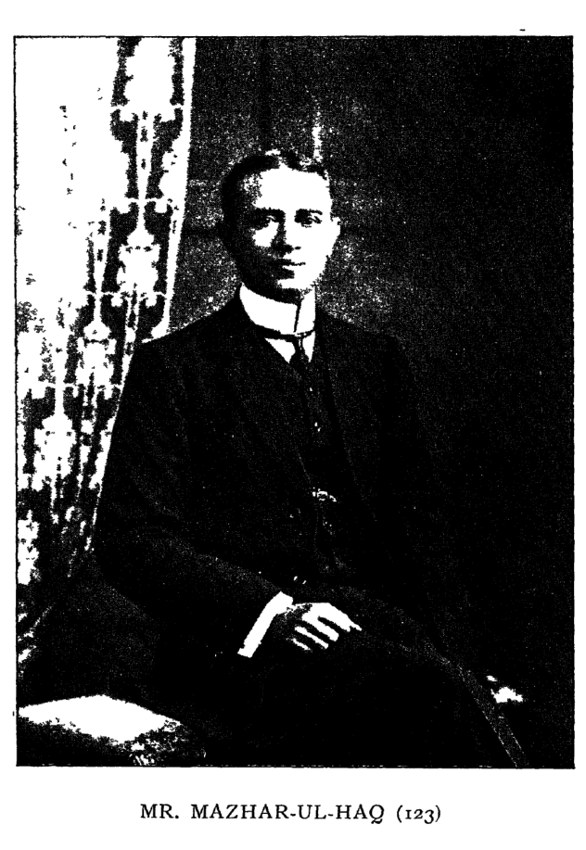
One of the most personal stories appears close to the end of the Bengal section. Mazhar-ul-Haq had studied in Patna and at Canning College in Lucknow. His family had resisted his wish to study in England. In 1888 he boarded a pilgrim steamer from Bombay to Aden with twenty rupees in his pocket. At Aden he waited three months for money from his relatives. The printed account dates his arrival in London to 15 September. By carrying the story past departure, the directory preserves a practical difficulty that often disappears from an account of an overseas education. A place in the next chapter of his life depended on the arrival of a remittance.
His friends in London called him a bookworm. He spent time at the British Museum and the Middle Temple Library and was called to the Bar in 1891. Back in India he later helped administer famine relief in Saran and served in municipal government at Chhapra. The entry credits improved municipal finances with making a market costing Rs. 20,000 possible. The imperial legislator’s title heads the page. Farther down are the twenty rupees on which he left home and the market that a town could afford. Between those two sums, a reader begins to see the shape of a life.
Sources and original pages
- Read the publisher’s preface on the Urdu predecessor
- See the 1902 Urdu volume from Rampur Raza Library
- Find a region in the contents of the 1911 work
- Open the life of Sultan Jahan Begum
- Read the eye specialist’s entry
- Find Ram Saran Das of Fyzabad
- Follow Hira Lal’s scholarship
- Read Mazhar-ul-Haq’s voyage from Bombay to Aden