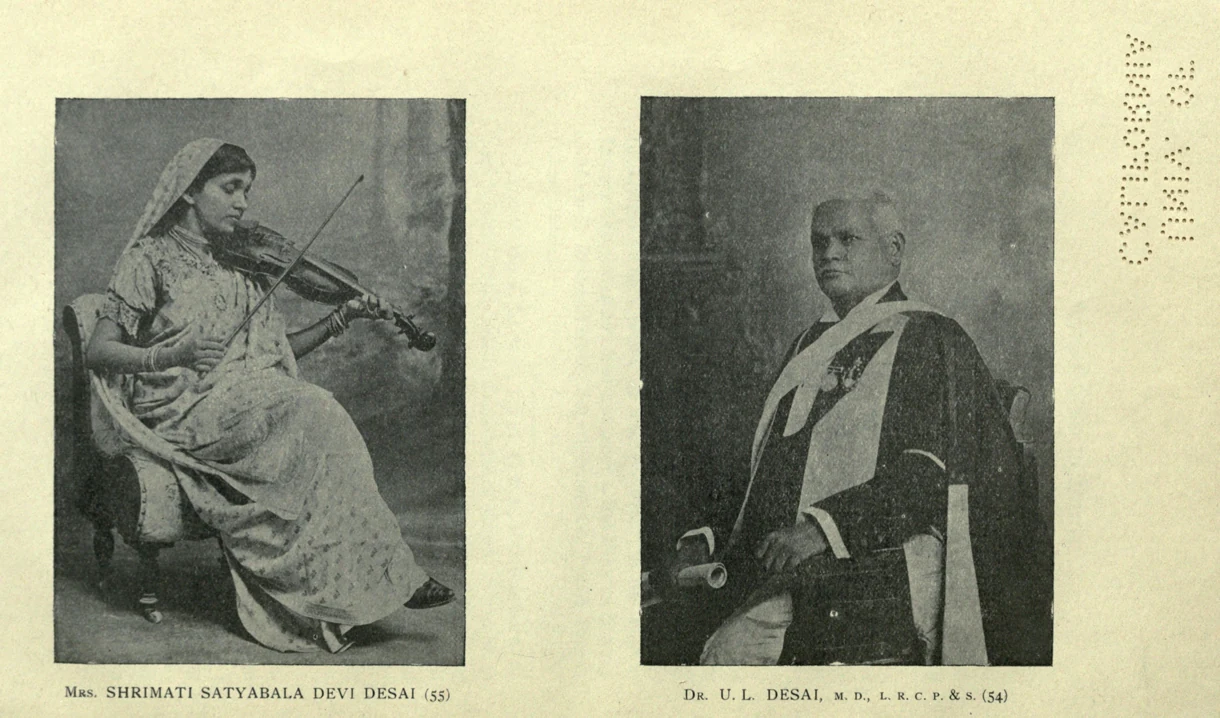
At the end of Satyabala Devi Desai’s entry, the reader gets an address in Rampur. By then she has taken us a considerable distance. She played the vina for audiences in Lucknow, Lahore and Madras. She lectured on Indian music abroad. Most remarkably, the 1914 account credits her with setting nearly four thousand pieces of classical music down in notation in her own hand. It even finds room for her sketches of the Ganges. She was about twenty-one when the account appeared.
Her biographer calls her a “scientific musician”. It is a description worth pausing over. A concert ended when the audience went home. Writing the notes gave another musician a means of studying a performance long afterwards. The little biography has done something similar for Desai. A reader in Lucknow today can still learn what she did with a pen as well as with an instrument.
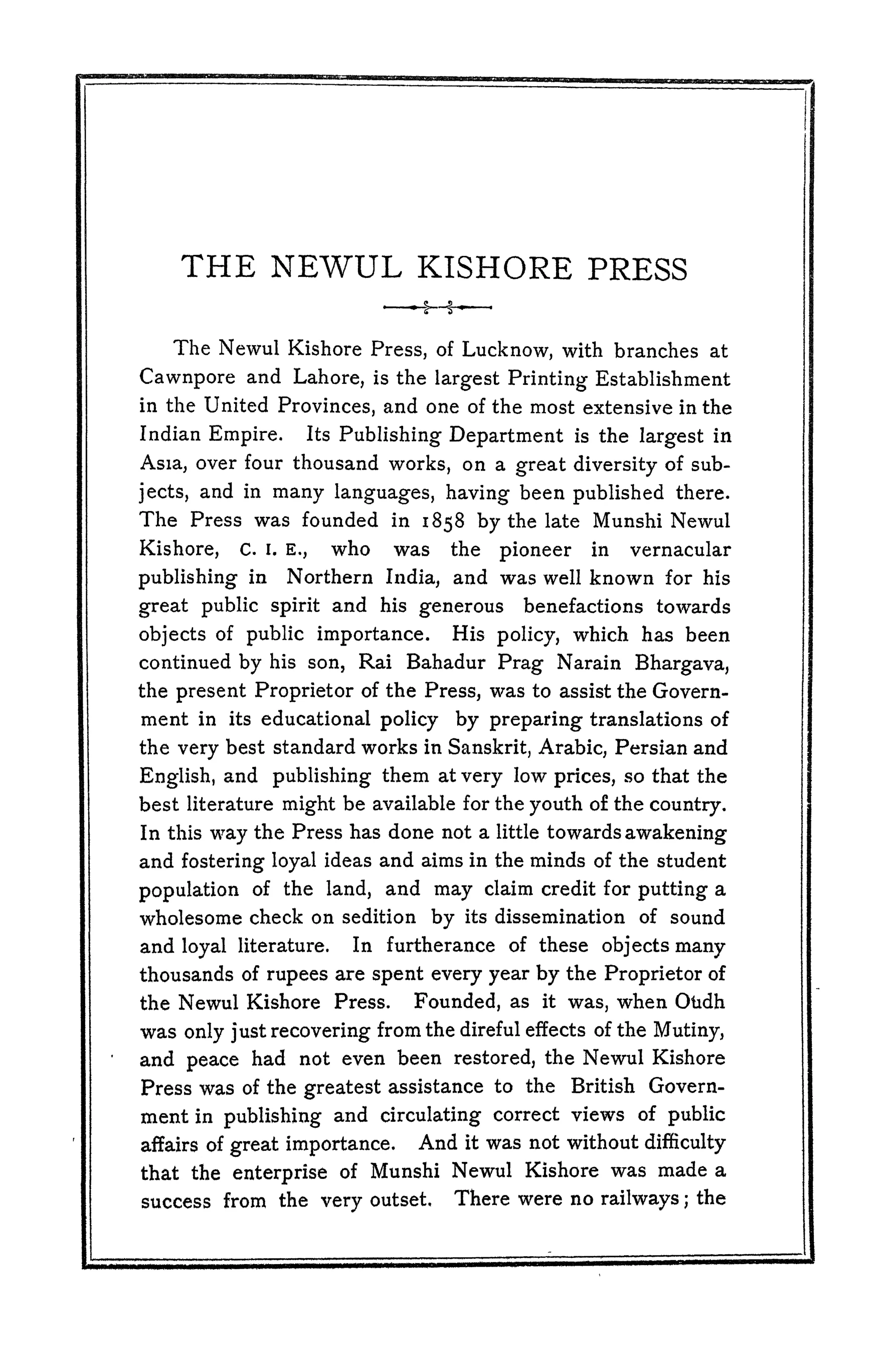
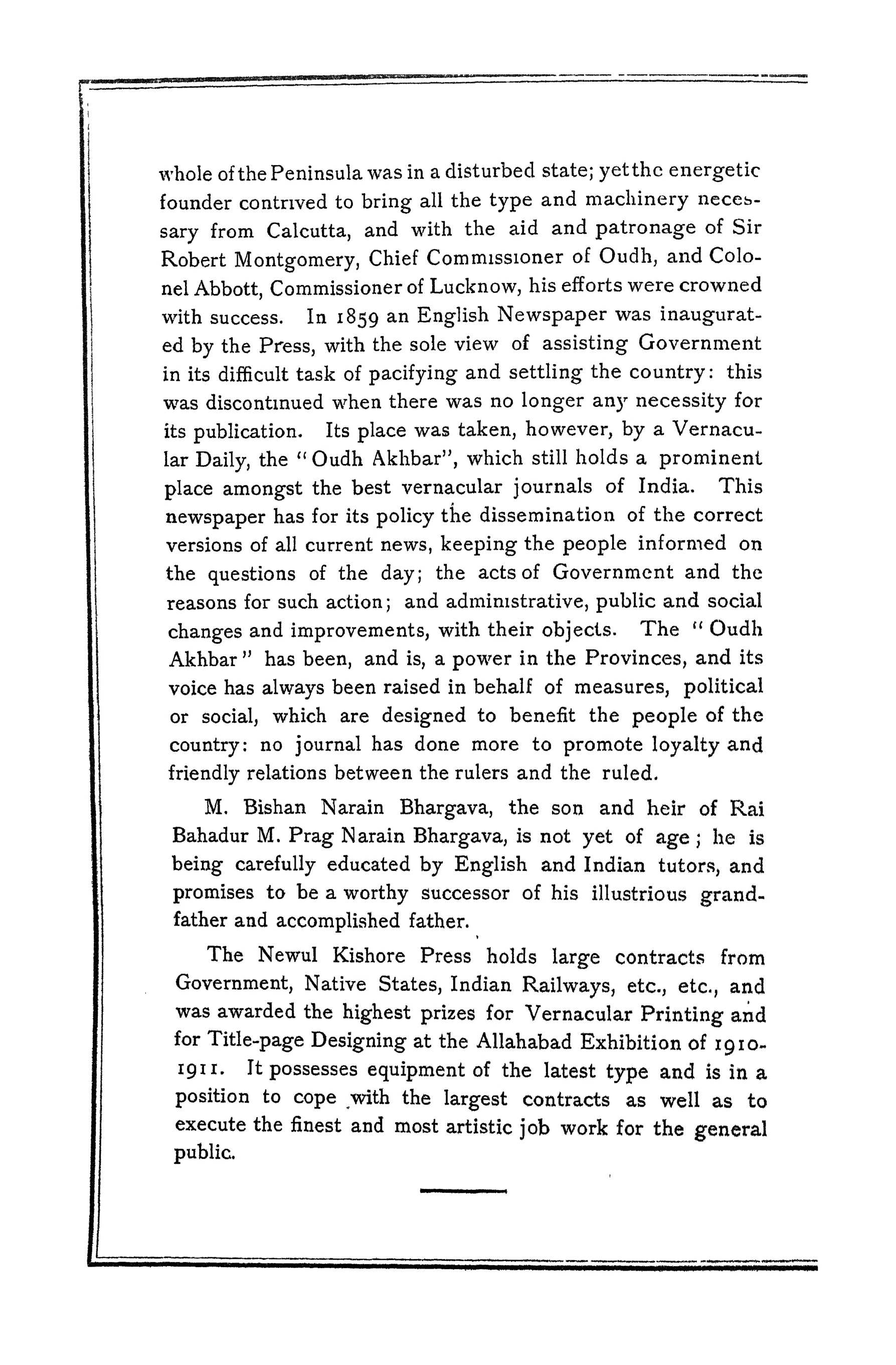
The book that preserves her name is Who’s Who in India. Its publisher was the Newal Kishore Press of Lucknow, whose English imprint on these title pages reads “Newul Kishore Press”. The Coronation Edition bears the date 1911. A first supplement followed in June 1912 and a second in June 1914. The three publications catch people in mid-career. Look past the honours after their names and you can meet the engineer who tackled brackish wells, discover where a woman could obtain legal advice, and see how a family printing house understood its own place in India.
The publisher among his subjects
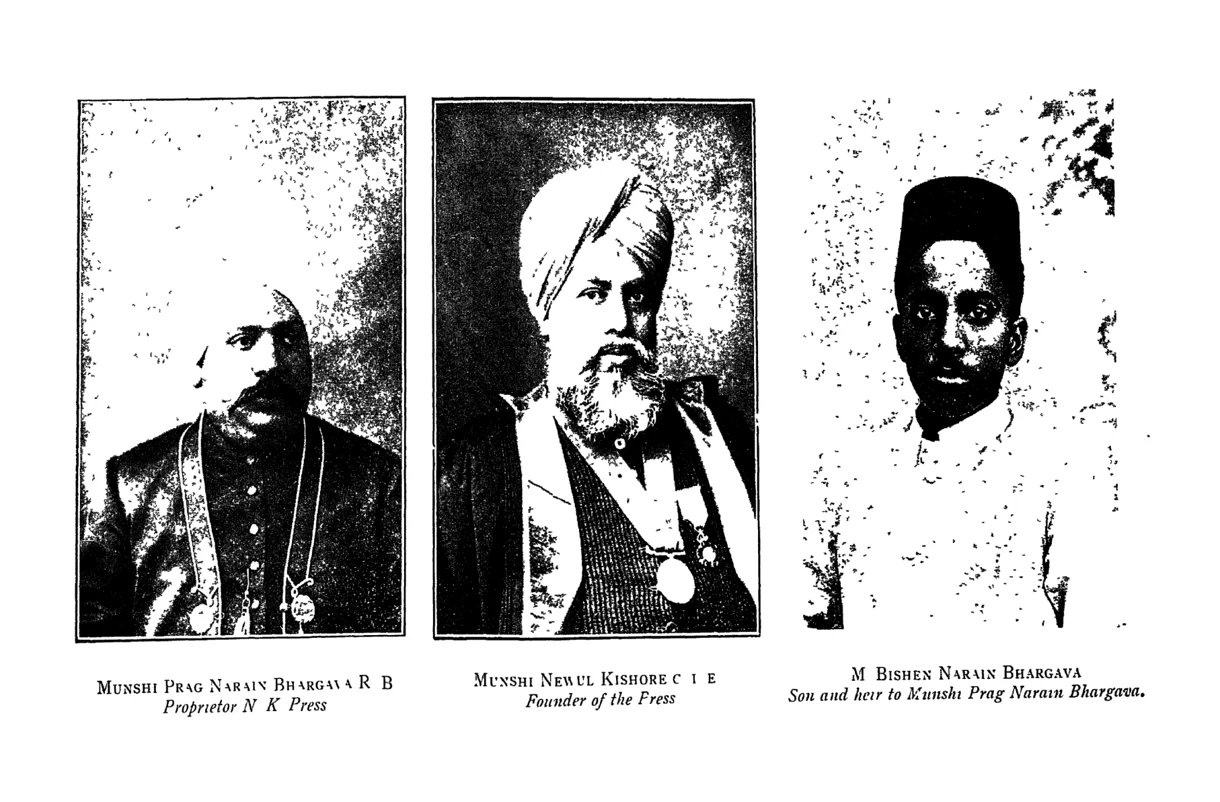
The directory has an unusual answer to the question of who made it. Turn to page 169 of the United Provinces section and the proprietor himself is there. Rai Bahadur Prag Narain Bhargava had studied at Canning College in Lucknow and served an apprenticeship with his father, Munshi Newal Kishore. His entry places the printing press alongside an Urdu newspaper, ironworks and an ice factory. It also lists a directorship in a paper mill. A reader setting out to find a publisher has stumbled upon a piece of Lucknow’s industrial history.
Munshi Newal Kishore founded the Press in 1858 and died in 1895. By the time his son undertook the directory, it could draw on decades of work across languages. The son’s entry remembers an Urdu translation of a medical work by Ibn Sina, known in English as Avicenna, and the founder’s patronage of the Urdu novel Fasana-e-Azad. The Press’s notice at the back of the book names its branches in Cawnpore, now Kanpur, and Lahore. It describes supplying printed work to railways and princely states and selling inexpensive translations to students. Booksellers, government purchasers, scholars and newspaper readers all came within its reach.
Prag Narain signed the 1914 preface in Lucknow. He thanked the people who had helped assemble the volume and explained that readers and patrons wanted an update. He wanted people elsewhere in India, and abroad, to know more about those whose work had earned recognition. The making of the books left other signatures too. The first supplement names Manohar Lal Bhargava as its printer. The family plate at the back of the 1911 volume places the founder between his son and grandson, so that a reader can put faces to the succession.
A coronation and two corrections
At the Delhi Durbar on 12 December 1911, George V and Queen Mary appeared before an assembly of princes, officials and invited spectators. It was there that the transfer of the imperial capital from Calcutta to Delhi was announced. The Lucknow Press marked the occasion in print. Its principal work arranged lives by region and rank. The 1912 supplement brought together the recipients of the Durbar honours with an illustrated account of the royal visit, beginning with the arrival of the royal yacht Medina at Bombay on 2 December. Someone who bought the supplement for the spectacle could also use it to look up the person who had received a title.
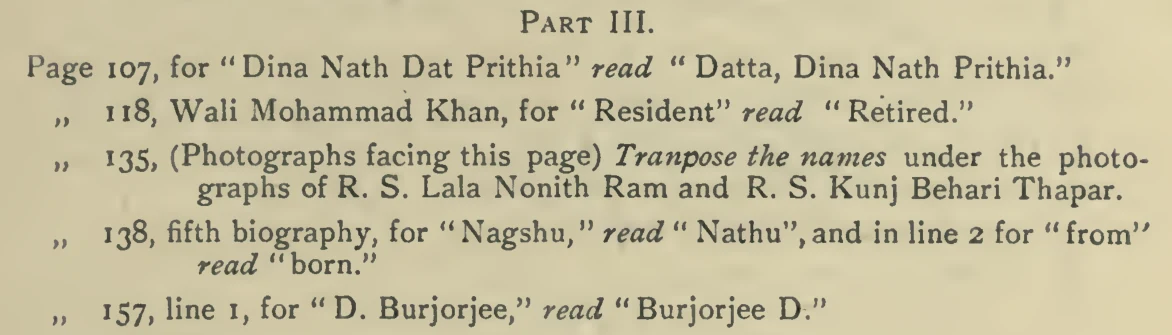
The supplement opened with corrections to the principal work. In Part I of the original, one passage said that a person could manage something when it ought to have said advise. The distinction matters to anyone trying to establish who could make a decision. A second instruction concerned two men pictured opposite page 135 of Part III. Their names had been printed under the wrong portraits. The Press told readers to exchange the captions. More than a century later, that small act of editorial repair still determines whose face a family might recognise.
The books assumed a reader willing to move back and forth. The opening entry in 1914 introduces Kunwar Bam Bahadur Shah of Kheri, educated at Canning College and active in the administration of the Khairigarh estate. For the family history it sends the reader back to page 88 of Part IV. There, in the principal work, the entry is under Rani Surat Kunwar. Follow that direction and the centre of the story shifts. The younger man’s career leads back to a woman who held a hereditary title and whose address the earlier volume gives as Singahi, Kheri.
Who put the Durbar together
The 1912 supplement lets a reader enter the Delhi Durbar twice. In the opening account the scene is viewed from the amphitheatre. The King speaks, the ruling chiefs advance in order, and the Nizam of Hyderabad leads the homage. The second way in is through the biographies. Turn to page 160 and there is a man from Lucknow whose services the Durbar Committee borrowed from Gwalior.
Chunilal Tulsiram had begun in the Government Telegraph Department. After a spell in the Gwalior stores he became superintendent of the Maharaja’s palace gardens and bunds, the embankments that held back water. The supplement says he received the title of Rai Saheb for his work at Delhi. It gives no account of what he planted or built there. What it does preserve is the route by which a Lucknow schoolboy acquired responsibilities in Gwalior and a place in the making of an imperial ceremony. For a visitor interested in gardens or the work behind a public event, his is a name worth taking away.
Other notices updated careers the Press had already documented. Page 61 records that physicist Jagadish Chandra Bose had received the insignia of Companion of the Order of the Star of India. For his work it directs readers to page 57 of the original Bengal section. There they could find an instrument he designed to study electric waves and a list of publications on how plants respond to stimuli. Readers who owned both volumes could follow the evidence from a medal back to an experiment.
The work behind a title
Under title-holders in the United Provinces is a man whose most telling achievement lay underground. Ahmad Husain Faridi had trained at Roorkee and worked on railway bridges at Sukkur and Garhmuktesar, and on Government House at Naini Tal. What earned him the title of Khan Saheb in 1906, according to his entry, was his work on water supply. He improved drinking-water wells in the Terai. In Etah he was asked what could be done about wells yielding brackish water. The directory records that his scheme succeeded. It gives the engineer his due and leaves an enticing question for the next researcher. What did he change in those wells?
On the next page, Lucknow’s municipal commissioner Mohammad Ghulam Husain Khan appears with the same title. Before he sat on the municipal board, he had personally helped vaccinate people. Later he became vice-chairman of its public health subcommittee. The entry follows his descent back to a prime minister of Nawab Asaf-ud-Daula, then ends with his taste for horticulture and driving. The last detail does something a list of office-holders seldom can. It gives us a glimpse of how a Lucknow public servant chose to spend his own time.
Some working lives get only three lines. Allah Din, from Sialkot in Punjab, was a bridge jamadar at the Madras Harbour Works. The 1914 supplement gives his post and the month his title was conferred. From those few words one can trace a working life between places now in Pakistan and India. About the bridge, the crew and Allah Din’s part in the job, the reader is left to look elsewhere. Set beside Faridi’s account, the brevity of the notice is itself a fact about whose technical work the directory could describe in detail.
A house in Poona and a missing name in Rangpur
The 1914 sketch of Ramabai Ranade begins, as many readers of its day might have expected, by identifying her as a judge’s widow. A page later we learn what she did with the house in Poona, now Pune, where she lived after his death. It housed the local Sevasadan, the women’s service organisation she led. She also went regularly to the Central Jail to teach women to read, write and count. During the famine of 1911–12 she and three other women went to Palanpur to distribute relief. Read through to those details and the house changes character. It becomes a place from which women organised work across a city and beyond it.
In the Bengal section, Cornelia Sorabji’s short entry records a different kind of access. In 1904 she became legal adviser to women observing purdah whose affairs came under the Bengal Court of Wards. Her education at Oxford, her public service medal and her book Between the Twilights all fit into the same few lines. Her clients are present only as a group. Yet their need for advice explains why that post existed, and why access to a woman trained in law could matter to a family’s affairs.
Occasionally the book brings us close to a woman and then loses her name altogether. Jadabeswar Tarkaratna of Rangpur, a Sanskrit scholar and dramatist, is praised for supporting women’s education. The entry lists several of his publications by title. Of his wife it says only that she was “an authoress of some distinction”. Which books did she write? Under what name could a reader ask for them? The directory gives Satyabala Desai a portrait and a record of thousands of pieces of music. For the writer in Rangpur, that single sentence is the lead it leaves us.
Reading before the outcome was known
The June 1914 volume gives us Rabindranath Tagore when his 1913 Nobel Prize for Literature was still news. Alongside the prize it describes his school at Santiniketan, near the place it calls Bolepur. Its readers learnt that about two hundred pupils were taught in the open air and that Tagore liked to swim and row. The university at Santiniketan still lay in the future. The man on these pages is a practising teacher and poet with a school large enough for its pupils to be counted.
The 1911 portrait of Gopal Krishna Gokhale preserves another kind of present tense. It follows a teacher of history and political economy at Fergusson College into public life, recounts his evidence before the Welby Commission on Indian expenditure and recalls a budget speech in which he proposed relief for cultivators. The writer admires a speaker able to inspire an audience without inflaming it. In that choice of praise one hears the political taste of the directory. The Press’s own notice was quite open about the value it placed on loyalty to British rule. Gokhale’s arguments about public money are there for a reader to follow, alongside a judgment about how such arguments ought to sound.
At the back of the volume, the index and the Press’s account of itself give way to advertisements. An advertisement for its Urdu daily, Oudh Akhbar, offers a Saturday summary of the week’s news and invites advertisers with expensive goods to sell. Suddenly we can see someone on the other side of the page. A publisher in Lucknow imagined a reader who might consult a national directory, follow the week in Urdu and place an order with an advertiser. That reader, as much as any medal or coronation, belongs in the history these books have kept.
Catalogue and sources
- The Coronation Edition, 1911 — Who’s Who in India, vol. II. Lucknow, Newul Kishore Press. The museum’s supplied transcription opens with the continuation of the United Provinces in Part IV. The digitised copy is from the Rashtrapati Bhavan Library, via the Digital Library of India.
- The first supplement, June 1912 — Supplement to Who’s Who in India. Lucknow, Newul Kishore Press. The supplied text and the digitised Popular Edition preserve the royal visit, Durbar honours and corrections. The title, printer and signed preface are on scan pages 11–13 in the 328-page University of California copy. Read the digitised volume ↗
- The second supplement, June 1914 — Second Supplement to Who’s Who in India, Brought up to 1914. Lucknow, Newul Kishore Press. The supplied text and the President’s Secretariat Library scan identify the Coronation Edition. The University of California Popular Edition preserves the same preface and the Desai portrait reproduced here. Compare the Popular Edition ↗
- Heidelberg University Library — Naval Kishore Press digital collection. Background on the founding of the publishing house and the dates of Munshi Newal Kishore’s life.
- Royal Collection Trust — The Imperial Crown of India. Background on the 1911 Delhi Durbar and the transfer of the capital.
- Nobel Prize and Visva-Bharati — The 1913 award to Tagore. Visva-Bharati’s institutional history dates the school to 1901 and the university to 1921. Visva-Bharati history ↗