Munshi Newal Kishore PressVIRTUAL MUSEUM · LUCKNOW
AN INTERACTIVE EXHIBITION

Who mattered
in 1911?

Lucknow, 1 December. Prag Narain Bhargava signs the preface to a book of people worth knowing. A ruler comes first. Keep turning and you find the work that kept a country going.

An encounter with Who’s Who in India
Newul Kishore Press, Lucknow · 1911
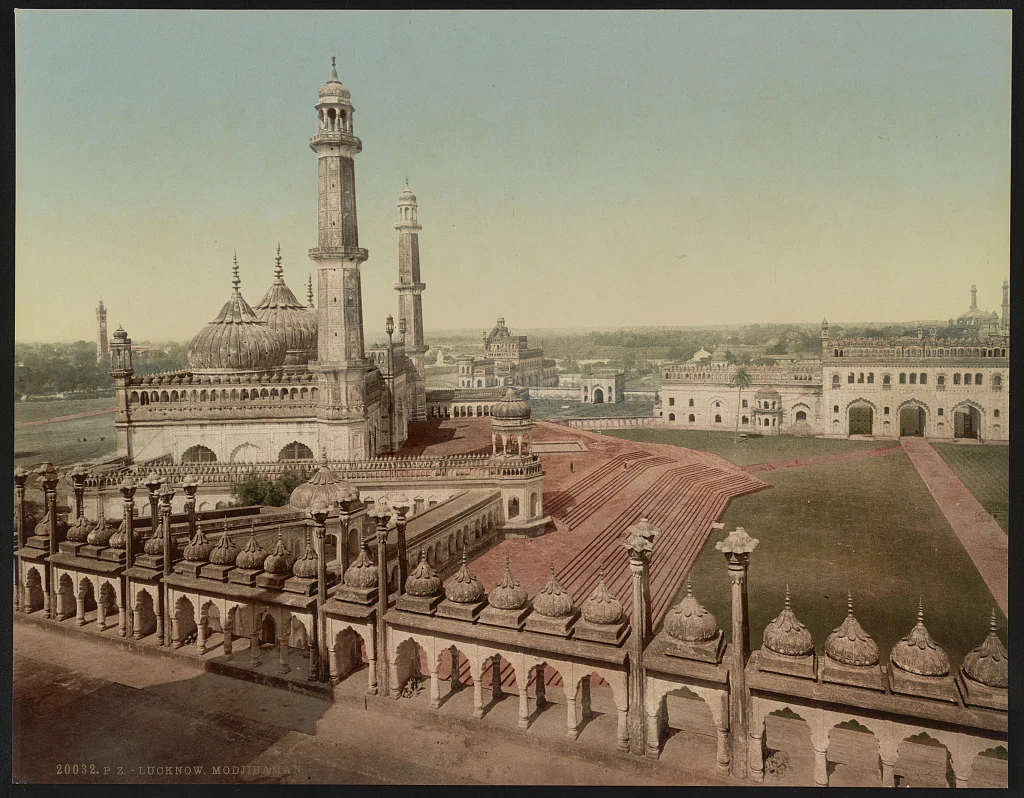
A colour photochrom of Lucknow seen from the Imambara, with towers, courtyard and gateways.
PLATE I Lucknow, seen from the Imambara
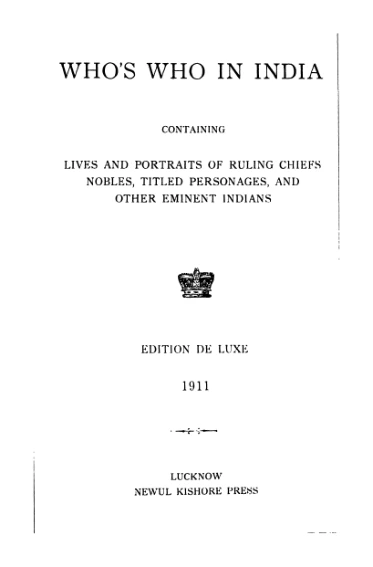
Original printed title page bearing the Lucknow imprint.
THE READING ROOM27 encounters✦Two original volumes✦Your own gazette
✦ FEATURED ORIGINAL · VOLUME II · 1911

The Newul Kishore Press

At the back of its great directory of people, the Lucknow press devoted two pages to itself. Here is its own account, complete, in the order in which a reader found it after the index.

01 / 02 THE PRESS AND ITS READERS
· Archive leaf 795
02 / 02 THE PAPER AND THE PRINTING WORKS
· Archive leaf 796
Read both pages in full Accessible transcription

ARTICLE PAGE 1 OF 2

The Newul Kishore Press, of Lucknow, with branches at Cawnpore and Lahore, is the largest Printing Establishment in the United Provinces, and one of the most extensive in the Indian Empire. Its Publishing Department is the largest in Asia, over four thousand works, on a great diversity of subjects, and in many languages, having been published there. The Press was founded in 1858 by the late Munshi Newul Kishore, C. I. E., who was the pioneer in vernacular publishing in Northern India, and was well known for his great public spirit and his generous benefactions towards objects of public importance. His policy, which has been continued by his son, Rai Bahadur Prag Narain Bhargava, the present Proprietor of the Press, was to assist the Government in its educational policy by preparing translations of the very best standard works in Sanskrit, Arabic, Persian and English, and publishing them at very low prices, so that the best literature might be available for the youth of the country. In this way the Press has done not a little towards awakening and fostering loyal ideas and aims in the minds of the student population of the land, and may claim credit for putting a wholesome check on sedition by its dissemination of sound and loyal literature. In furtherance of these objects many thousands of rupees are spent every year by the Proprietor of the Newul Kishore Press. Founded, as it was, when Oudh was only just recovering from the direful effects of the Mutiny, and peace had not even been restored, the Newul Kishore Press was of the greatest assistance to the British Government in publishing and circulating correct views of public affairs of great importance. And it was not without difficulty that the enterprise of Munshi Newul Kishore was made a success from the very outset. There were no railways; the

ARTICLE PAGE 2 OF 2

whole of the Peninsula was in a disturbed state; yet the energetic founder contrived to bring all the type and machinery necessary from Calcutta, and with the aid and patronage of Sir Robert Montgomery, Chief Commissioner of Oudh, and Colonel Abbott, Commissioner of Lucknow, his efforts were crowned with success. In 1859 an English Newspaper was inaugurated by the Press, with the sole view of assisting Government in its difficult task of pacifying and settling the country: this was discontinued when there was no longer any necessity for its publication. Its place was taken, however, by a Vernacular Daily, the “Oudh Akhbar”, which still holds a prominent place amongst the best vernacular journals of India. This newspaper has for its policy the dissemination of the correct versions of all current news, keeping the people informed on the questions of the day; the acts of Government and the reasons for such action; and administrative, public and social changes and improvements, with their objects. The “Oudh Akhbar” has been, and is, a power in the Provinces, and its voice has always been raised in behalf of measures, political or social, which are designed to benefit the people of the country: no journal has done more to promote loyalty and friendly relations between the rulers and the ruled.

M. Bishan Narain Bhargava, the son and heir of Rai Bahadur M. Prag Narain Bhargava, is not yet of age; he is being carefully educated by English and Indian tutors, and promises to be a worthy successor of his illustrious grandfather and accomplished father.

The Newul Kishore Press holds large contracts from Government, Native States, Indian Railways, etc., etc., and was awarded the highest prizes for Vernacular Printing and for Title-page Designing at the Allahabad Exhibition of 1910-1911. It possesses equipment of the latest type and is in a position to cope with the largest contracts as well as to execute the finest and most artistic job work for the general public.
Reading the publisher’s voice. The Press presents its low-priced translations, its Urdu newspaper Oudh Akhbar and its commercial printing contracts together. Its claims about scale and its praise of loyalty to British rule belong to this 1911 account by the publishing house.

THE PLATE THAT FOLLOWS

Three generations in one frame

The book places Munshi Newul Kishore, the founder, in the centre. His son Prag Narain Bhargava, the proprietor in 1911, is on the left. Prag Narain’s son Bishen Narain Bhargava is on the right. The caption uses Bishen, while the article spells his name Bishan.

· View the original leaf
01 THE DIRECTORY

Whose page will you open?

Follow the people who financed mills, fought famine, built institutions, shaped cities or changed how India learnt. Each contribution leads to a page in the 1911 directory. Places follow the book’s geography, including cities now in Pakistan and Bangladesh.

A place to begin · An Indian steelworks ↗A Rani’s work for girls ↗An experiment in Calcutta ↗

J JAUNPUR · A FAMILY HISTORY

From a Lucknow classroom to a Jaunpur auditorium

Open the directory at Jaunpur and two places come into the same story. In 1911 the young Raja of Jaunpur was a pupil in Lucknow. Today, a college in Jaunpur bears his name, and an auditorium there bears the name of the Rani who brought the Lucknow press’s story into this museum.

In the 1911 directory

The schoolboy and the estate

Sri Krishen Dutt Dube was born in 1896 and succeeded to the hereditary title in 1900. The Press traced the estate to the banker Sheo Lal Dube and a grant of Badlapur dated 3 November 1797. It counted 235 villages in Jaunpur and 69 in Azamgarh.

Turn the page and Rani Gumani Kunwar comes into view. After the death of her husband, Raja Shankar Datt, she chose the boy as heir under her authority to adopt a successor. When the directory appeared, the Court of Wards administered the estate while he attended Colvin Taluqdars’ School in Lucknow.

Open the Raja’s folio
The museum today

Rani Nita Dube

Rani Nita Dube, née Bhargava, is the promoter and Managing Director of Le Press, Chairperson of the proposed Newal Kishore Foundation, and the driving force behind the Munshi Newal Kishore Press Museum. Her family identifies her as the present Rani, or queen, of the erstwhile Jaunpur Riyasat.

A great-great-granddaughter of Munshi Newal Kishore, she led the revival of the family’s printing campus in Hazratganj. In Jaunpur, Raja Shri Krishna Datt Inter College preserves another part of this history. Its Rani Neeta Kunwar auditorium carries the name by which she is known locally.

The family supplied the current leadership roles and royal-house title. Local reporting uses the name Rani Neeta Kunwar.

Read the records behind this story
02 AT THE PRESS

Turn the calendar

Follow the book from an Urdu predecessor to the day its English preface was signed, then look ahead to the gathering in Delhi.

03 THE EDITOR’S DESK

Who gets the last word?

In Rangpur, the directory lists several books by the scholar Jadabeswar Tarkaratna. It also mentions that his wife was a distinguished author. It gives neither her name nor a single title by her. If you had a page to edit, whose work would you bring into view?

Read the Rangpur entry · Part V, p. 10 ↗

The books on the desk

1911 · Volume I
Edition de Luxe · 728 scanned pages
Turn the pages ↗

1911 · Volume II
Coronation Edition · 804 scanned pages
Turn the pages ↗

Find the 1912 and 1914 supplements →
THE 1911 DIRECTORY
THE ARCHIVAL DETAIL
100%

YOUR READING DESK